



Edition #28. India’s goal of achieving net zero emissions by 2070 is estimated to require investments worth $150-200 billion a year towards enabling its energy transition. British International Investment (BII) aims to play a meaningful role over the next five years in helping close the gap via a new £1.1 billion ($1.5 billion) climate-focused vehicle called British Climate Partners (BCP).
BCP will focus on India and six Southeast Asian economies including the Philippines, Indonesia, Vietnam, Thailand and Malaysia. Asian economies, according to BII, accounted for three-quarters of global coal demand in 2024, and BCP’s stated mandate is to build and scale investible climate projects, reduce early-stage risks and attract long-term commercial investors.
“Through BCP, BII will mobilise private capital alongside its own, working in partnership with private investors to deploy capital through a combination of equity platforms and mezzanine finance,” the UK government-owned development finance institution (DFI) said on April 23 when it unveiled its global investment strategy for 2026-31.
India already accounts for 27% of BII’s roughly £7.3 billion ($9.8 billion) global portfolio – its largest country exposure by a wide margin. For India-focused private equity and venture capital firms focused on climate-specific or climate-adjacent strategies, the BCP mandate codifies a model – originate, de-risk and hand off – that the DFI has been polishing here for a while.
The wider shift
BCP sits inside a broader strategic recalibration at BII which envisages investments worth £15 billion over the next five years across climate and other projects. BII itself is committed to deploying £7–8 billion in direct investments. It aims to mobilise a further £6-7.5 billion from commercial private capital investors for the balance.
Three other shifts embedded in the strategy will shape what it backs over the next five years.
First, the plan narrows the DFI’s sector focus to three priority areas — financial services; power, trade and digital infrastructure; and sustainable industries.
Second, the climate finance target has been raised from 30% of commitments to 40% (including BCP), and the gender finance target has increased from 25% to 30% of core investments.
Third, 25% of new core investments will flow to countries classified by the UN as ‘least developed’. India does not qualify.
What emerges is that BII wants to be a more catalytic DFI, one that creates the architecture for commercial private capital participation at scale in climate financing and the broader sustainable investing spectrum.
An India-specific example it cites in the 2026-31 strategy document is the 2017 investment in Ayana Renewable Power. Started as a wholly-owned subsidiary of BII (known as CDC at the time) with an initial investment of $100 million, Ayana went on to raise over $1 billion from investors including the National Infrastructure Investment Fund (NIIF), Green Growth Equity Fund and Eversource Capital. By 2023, Ayana had over 4 GW of renewable energy capacity. BII and the other investors exited the investment last year when an ONGC and NTPC joint venture acquired Ayana at an enterprise value of $2.3 billion.
BII’s more recent moves in India
The DFI’s investments since January this year have all been climate-adjacent.
In February, it committed $42 million to Ecofy, a Mumbai-based green finance NBFC that lends for EVs and rooftop solar, alongside Finnfund, Eversource Capital and FMO. The same month, Turno, a Bengaluru-based EV distribution and financing platform, received a $4.7 million follow-on cheque to launch an intercity e-bus financing unit called ElectricGo. In January, BII co-invested in Aerem Solutions’ $15 million pre-Series B, a solar-financing NBFC round led by SMBC Asia Rising Fund. This month, it led an $80 million investment in Polaris Smart Metering, a Jaipur-based smart grid and low-cost smart meter maker.
None of these four transactions reflects the equity-platform or mezzanine-finance architecture BCP is being built around. All of them are direct, balance-sheet commitments to operating companies. Directionally though they point to BII’s sharpened focus on climate financing.
In February, it also announced that climate investments in India had reached $1.1 billion, exceeding targets. Shilpa Kumar, managing direct and head of India, described the country as “central” to the firm’s climate strategy.
Who else is writing cheques for climate
BII is far from the only source of climate capital flowing into India this year. On Friday, for instance, World Bank arm International Finance Corporation outlined plans to scale annual investments in India to $10 billion by 2030, according to a Reuters report. Target sectors include renewable energy, urban infrastructure and financial services.
Deal activity in climate and cleantech for the first four months of 2026 reveals a market that is broadening across stages, structures and investor types.
At the growth end, PMI Electro Mobility raised a $310 million growth round led by KKR to build out EV buses for public transport; and Radiance Renewables raised $100 million from Impact Fund Denmark and FMO.
At the Series B-and-above mid-market, Varaha (carbon credits) raised $45 million led by WestBridge Capital, Euler Motors closed a $46.2 million Series E led by Lightrock (with Hero MotoCorp and Blume returning), and EV charging infrastructure player Statiq raised $18 million.
Early-stage capital continues to flow into cleantech: Newtrace (green hydrogen electrolysers) raised a pre-Series A led by HDFC Bank and Mitsui Sumitomo Insurance Group with Peak XV Partners participating; Meine Electric (iron-air batteries) raised seed capital from Antler; and Astranova Mobility raised a $6.4 million Series A for EV financing, with the Asian Development Bank joining IvyCap Ventures on the cap table.
The investor universe at the early and growth stages includes domestic venture capital firms, family offices and corporate venture arms, and a widening set of global DFIs and specialist climate investors. The ticket sizes at the growth end are increasingly funded by global strategic capital and infrastructure-style vehicles. The middle of the market, where BCP’s mezzanine and platform capital is being aimed, is where the structural gap remains.
Given the Indian portfolio’s weight in BII’s existing asset base, the odds favour India featuring early in BCP’s deployment. Importantly, what BII’s new strategy ultimately represents is a maturing of the development finance model in the Indian context.
The Week in Deals
Healthcare, Gaming, Vertical AI Apps Drive Dealmaking
Yet another slow week for dealmaking dominated largely by vertical AI applications across sectors. Two homegrown gaming studios found capital and healthcare was another notable underlying theme. The week closed on a slightly optimistic note with the launch of a $600 million-plus early stage technology fund backed by South Korean technology majors.
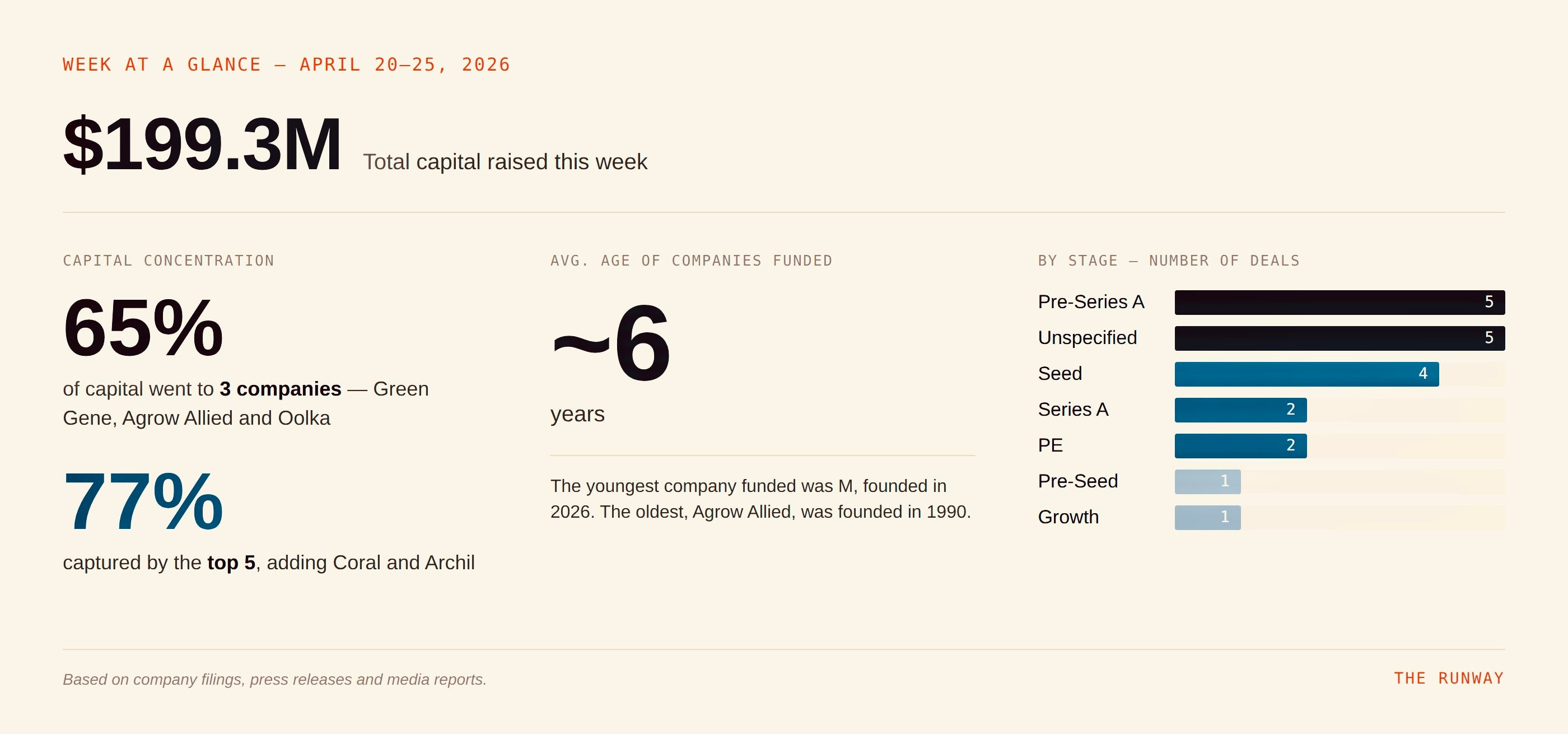
Green Gene Enviro Protection and Infrastructure raised Rs 900 crore ($95.9 million) in a secondary transaction led by JM Financial Private Equity. A group of family offices including SRF Family Office joined the round. The Surat-based company specializes in the collection, treatment, and processing of hazardous waste generated from manufacturing sectors towards the production of alternative fuel.
“As environmental regulations tighten and demand for responsible waste management grows, we see significant long-term potential in the company,” JM Financial Private Equity managing director Vinit Rai said in a statement.
The deal comes a week after the private equity firm led a Rs 150 crore investment in NG Electro Products, a contract manufacturing company that serves consumer brands across home care, beauty and personal care, and nutraceuticals.
Agrow Allied Ventures raised $20 million from ICICI Venture. The Gurugram-based company manufactures generic and formulated agro-chemicals across herbicides, weedicides, insecticides, and fungicides.
Oolka raised $13.8 million in a Series A round led by Accel, according to multiple media reports citing regulatory filings. Existing investors Lightspeed and Z47 joined the round. The Bengaluru-based fintech offers AI-powered credit management solutions.
Coral raised $12.5 million in a funding round co-led by Z47 and Lightspeed. The New York-based healthcare automation startup, which also has operations in Bangalore, builds tools to streamline back-office workflows that still rely heavily on manual coordination and fax-based systems.
“US healthcare admin carries over a trillion dollars in overhead each year… Our thesis is that the most compelling AI opportunities lie in workflow-heavy, tech-underserved categories that demand deep vertical expertise to crack,” Z47’s Ashwin KP said in a statement.
LightFury Games secured $11 million in a pre-Series A round from Blume Ventures, V3 Ventures, MIXI Global Investments and Times Internet. The round also saw participation from cricketers, including MS Dhoni, Jasprit Bumrah, Shreyas Iyer, and Hardik Pandya. The Bengaluru-based gaming studio is expected to launch its AAA title, eCricket mobile game, later this year.
Archil, a San Francisco-based startup building a cloud filesystem f0r AI-native applications, raised a $11 million Series A from an investor group that included Peak XV Partners. The round was led by Standard Capital and other co-investors included YCombinator, Felicis and Wayfinder Ventures.
M, Dunzo co-founder Kabeer Biswas's new concierge services startup, raised a Rs 102 crore ($10.8 million) seed round led by Peak XV Partners. Blume Ventures and CRED joined the round. M proposes to use AI to handle everyday household tasks.
STCH raised $7 million in a pre-Series A round led by Omnivore. Kae Capital joined the round. The Bengaluru-based startup enables fashion brands to design and manufacture fabrics faster and more efficiently using AI and a contract manufacturing model.
Khetika raised an undisclosed sum in a funding round led by Ayra Ventures. Existing investors Narotam Sekhsaria Family Office and Anicut Capital participated in the round. The Mumbai-based company makes and retails preservative-free staples, spices and dry fruits.
NewEra Hospitals raised an undisclosed sum in a growth round from Premji Invest. The investment will enable NewEra Hospitals to deepen and expand its quaternary care services, said a statement.
The Mumbai-based company currently operates two hospitals in Nagpur and one in Navi Mumbai, which offer complex specialties including neurosciences, transplant, and cardiology. It plans to launch three new hospitals in Nagpur, expanding its capacity to 800 beds from 350.
“Structural gaps in India’s healthcare delivery system persist. Nagpur, in particular, requires a higher bed density and an improvement in hospital infrastructure,” Prakash Chellam, partner and head of healthcare and life sciences at Premji Invest, said.
Other deals this week:
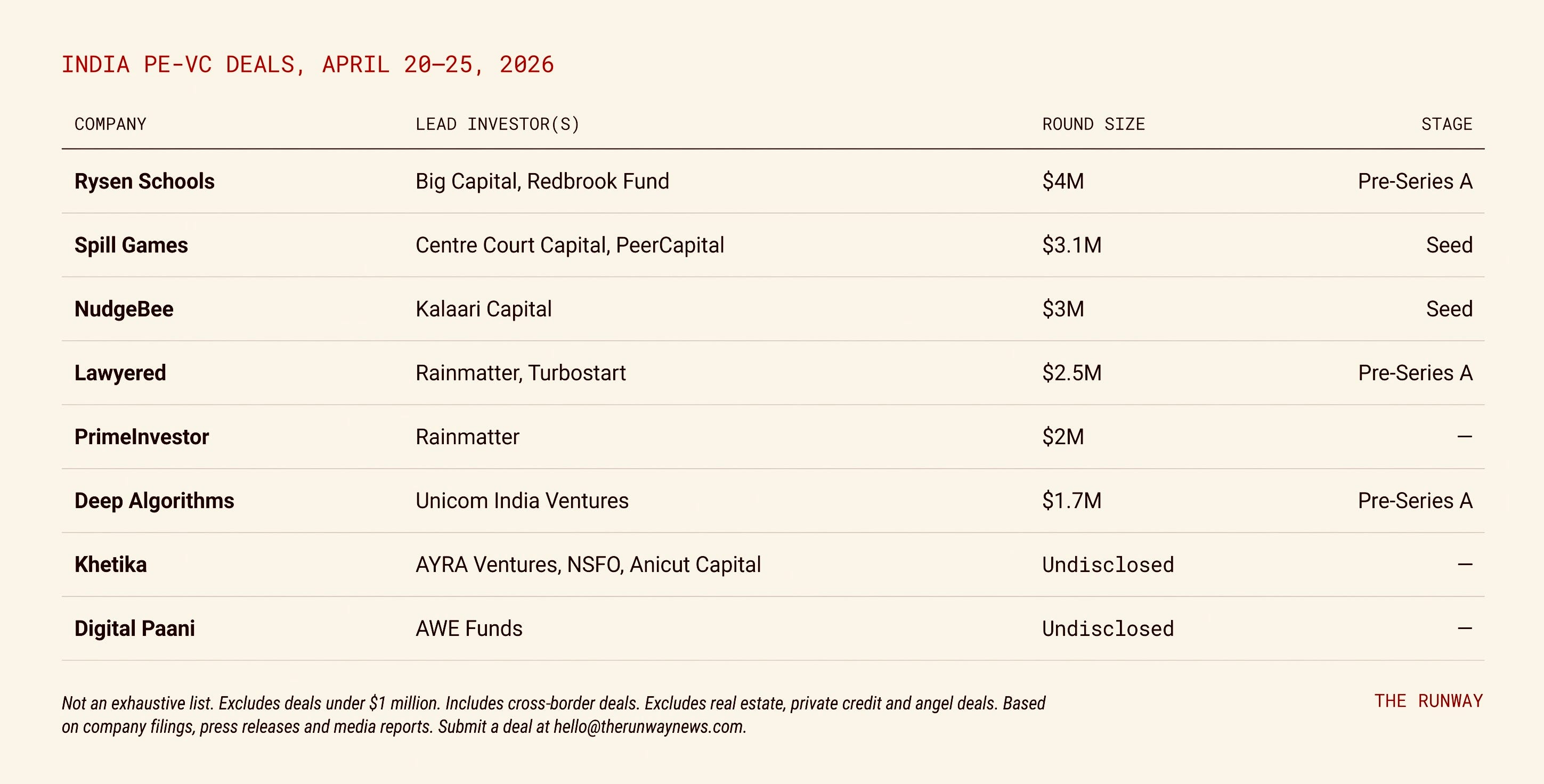
Sub $1 million deals: Skincare brand Clarity Global Labs raised $0.4 million led by Artha Venture. Clean food QSR chain Acai Theory raised $0.4 million led by All In Capital. Surgical care hospital network Axten Hospitals raised $0.2 million in a round led by PedalStart.
Among deals in play, a TPG-led consortium formalised an agreement to acquire Aseem Infrastructure Finance for Rs 4,000 crore, Bloomberg reported, citing anonymous sources. The consortium includes Singapore’s GIC and ICICI Bank. The NIIF-backed NBFC, which provides financing for infrastructure projects across renewable energy, electric mobility, roads and airports, will be merged with a newly created joint venture entity, the report said. On-demand domestic help services platform Pronto is in talks for a new funding round, The Morning Context reported. Lachy Groom may invest $20 million at a $200 million valuation, the report said.
In a big boost for technology startups, South Korea’s Krafton and Naver launched Unicorn Growth Fund, a Rs 6,000 crore ($636 million) fund to invest in early and growth stage startups in India. Mirae Asset Venture Investments will manage the fund.
Submit a deal for The Runway Briefing by replying to this email or write to us at hello@therunwaynews.com.
Recco | Notes on Culture, Craft and the Considered Life
A Serious Win for Indian Cheese

India doesn’t usually come up in conversations around serious cheese. But at the Mundial do Queijo do Brasil earlier this week, it made a noticeable showing.
The country picked up four medals at the São Paulo competition, which drew over 2,700 entries.
The standout was a Super Gold for Gulmarg, a brie-style cheese made by Mumbai-based Eleftheria. The brand also picked up a Gold for its brunost and a Silver for Kaali Miri, while a soft yak churpi from Ladakh won Gold.
That matters because of the category. Soft-ripened cheeses are hard to get right anywhere. In India, you’re working against heat, humidity and uneven handling. Getting a clean, consistent result is the real achievement.
For years, the top end of the market has been import-led. That hasn’t flipped, but it’s no longer the only option.
Eleftheria’s cheeses are available to order online, which removes some of the usual friction around access. If you’re curious, start with Gulmarg. It’s a good reference point for how far local cheesemaking has come.
Recco is a column by Murali Menon. Murali has spent a career paying close attention to how things are made, where they come from, and why some of them endure. Every edition, one recommendation: a maker, an object, a place, a practice.
Thank you for reading The Runway. We’d love to get your feedback. Drop us a line at hello@therunwaynews.com or just reply to this email.