


Signalling tougher times ahead for the economy, the government this week urged citizens to cut back on spends most likely to impact India’s import bill. In Edition #31 we look at what a stressed economy could mean for consumer businesses backed by private capital. Plus all the other deals you need to know about.
Times are hard but that’s no reason to stop appreciating the finer things in life – scroll down to the Recco section.
New to the The Runway? Subscribe for a comprehensive view of the deals, strategies and people shaping India’s private equity and venture capital markets every week. We’re also on LinkedIn and WhatsApp if you want to keep track of updates on future editions.
Back to Basics for Consumer Businesses

When India’s Prime Minister urged citizens last Sunday to defer gold purchases, reduce fuel consumption and avoid non-essential foreign travel, it was a signal that the economy is under severe stress. Since then, import duties on gold and silver have been raised, petrol and diesel prices have increased, and the rupee has fallen to a record low.
For the private equity and venture capital (PE-VC) firms that deployed capital into India’s consumer sector, another recalibration of return timelines may be in the offing. The sector had only just emerged from a reset. It weathered a prolonged funding downturn and investments gained momentum again last year. The Runway tracked more than forty consumer-facing investment rounds since January 2026 alone, spanning food and beverages, beauty and personal care, apparel, travel and quick commerce.
All of those categories are expected to take a hit from slower consumer demand, particularly on discretionary spending. But each faces specific challenges in varying degrees.
A closer look at some of the key categories:
Food and beverages
Food and beverage (F&B) businesses are exposed to rising costs in crude-linked inputs — packaging laminates, polyethylene and surfactants. Edible oil prices, a key input across snack and condiment categories, have added further pressure. On the demand side, higher fuel prices translate into higher freight and last-mile delivery costs, which often tend to be passed on to the consumer. For cloud kitchen and quick-service restaurant operators, LPG costs are a direct operational line item. Franchise operators with royalty structures denominated in dollars carry an additional layer of currency exposure that widens with each move in the rupee.
Recent F&B deals:
Fireside Ventures and Sharrp Ventures led a $5 million round in Troovy. Sofina and Sauce VC led a $51 million Series D in The Whole Truth. Both are clean-label packaged snacks brands.
Playbook Partners led a $15 million round in Subway franchise operator EverBrands. Hara Global Capital Management and Bain Capital Ventures led a $38 million Series B in quick food delivery platform Swish. Bikaji Foods Family Office led a $7.5 million Series B in cloud kitchen Dil Foods.
Temasek invested $50 million in dairy products maker Milky Mist’s pre-IPO round.
Beauty and personal care
Several homegrown beauty and personal care brands source active ingredients from Europe and Korea. The rupee's depreciation raises the effective cost of those imports. Polymer-derived packaging — tubes, pumps and laminate pouches — has become more expensive as crude prices rise.
Formulation costs and packaging costs are moving up together. Brands will either have to defer profitability milestones or raise prices and risk losing customers.
Recent deals in beauty and personal care:
360 One Asset led a $21 million round in Mosaic Wellness. Orbimed Asia Partners led a $32 million Series C in hygiene products brand PeeSafe.
Fireside Ventures led a $5 million Series A in Chosen and a $3 million seed round in Antinorm.
Dabur Ventures and Unilever Ventures led a $7.5 million Series B in RAS Beauty.
Apparel
Polyester is a crude oil derivative and accounts for a significant share of fabric input costs across fast fashion and athleisure categories. Rising polyester prices have already been flagged as a source of margin pressure going into early FY27, particularly for brands that have been expanding offline rapidly. The combination of higher fabric costs, elevated store rentals and a consumer whose budget is under pressure from fuel and food inflation creates a difficult operating environment.
Brands that have invested in distinctive positioning and compete on identity rather than price have more room to absorb or pass on cost increases than those whose primary proposition is value.
Recent deals in apparel companies:
Jungle Ventures led a $25 million Series A in Escape Plan. Z47 and Accel led a $9 million Series A in Aramya.
RPSG Capital Ventures led a $4.3 million Series A in MyDesignation. Sharrp Ventures led a $4.3 million Series A in Cava Athleisure.
Fireside Ventures led a $3.8 million Series A in Kisah.
Quick commerce and consumer-tech
Ride-hailing and quick commerce platforms face a specific challenge from the fuel price increase: driver economics. Two-wheeler drivers, who form the backbone of delivery and ride-hailing supply in Indian cities, face a direct and immediate rise in operating costs. On-demand domestic services platforms are similarly exposed.
Quick commerce operators — whose gross order values have been among the strongest signals of India’s consumption momentum — may also see basket composition shift away from discretionary add-ons toward core essentials. The urban consumer remains willing to pay for convenience, but that willingness will soon be tested against a household budget simultaneously facing higher fuel, food and essentials costs.
Recent consumer-tech deals:
Prosus led a $240 million round in ride-hailing platform Rapido.
Susquehanna, Mirae Asset and Bertelsmann invested $56 million in on-demand household help platform Snabbit. Epiq Capital, General Catalyst and Lachy Groom invested $45 million in rival Pronto.
Familiar drill
India's broader consumption story is not broken. Private consumption is close to 60% of GDP, a sustained premiumisation trend is underway and brand consciousness is rising across income segments. But the near-to-medium term operating environment, across input costs, currency and consumer sentiment, is harder than the one in which most of these rounds were closed.
For businesses planning their next fundraise, the environment has shifted. Investors doing diligence will apply more conservative revenue growth assumptions and higher cost assumptions than they would have three months ago.
The good news is that consumer businesses — and the investors backing them — have been through this drill recently. The funding downturn that starved companies of capital for nearly three years sharpened the focus on unit economics and profitability pathways. That discipline will be tested again.
The Week in Deals
Rapido Scores a Valuation Jump; Local VCs Go Global
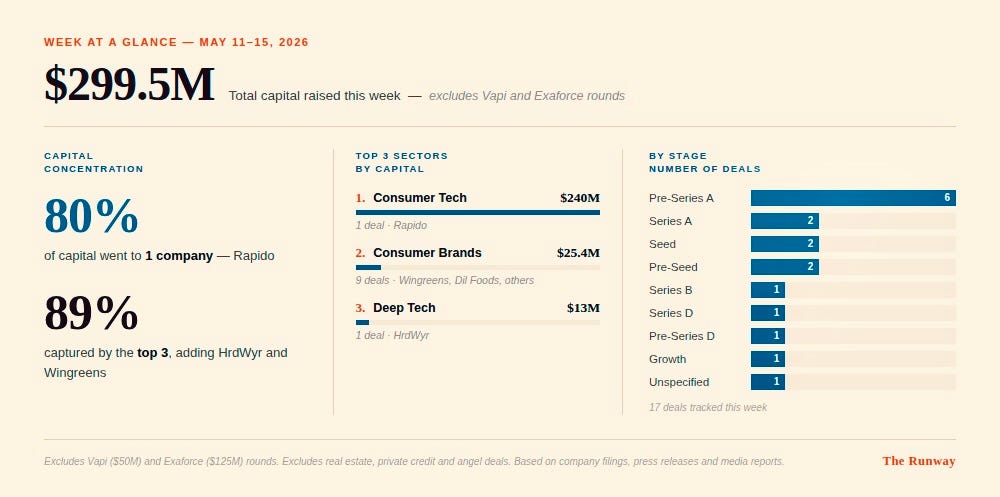
Slim pickings this week in terms of PE-VC investment activity. Despite the immediate future looking a bit grim, consumer deals dominated the charts across brands, services and platforms. Also, in line with a growing pattern, two homegrown VC firms struck AI-related deals overseas.
Peak XV Partners had a busy week overseas. The Mumbai-based VC firm has been building out a largely AI-centric portfolio in the US for a couple of years, even as it continues to be a prolific investor across sectors at home. The firm’s deals from this week were:
Vapi – Led a $50 million Series B round in the San Francisco-based enterprise voice AI startup. Bessemer Venture Partners, YC, M12 and Kleiner Perkins joined the round.
Exaforce – Joined the AI security startup’s $125 million Series B round. HarbourVest, Mayfield, Khosla Ventures and Seligman Ventures were also part of the round, the San Jose, California-based startup said in a statement. It serves enterprise security teams across sectors such as healthcare, technology and financial services.
Rapido raised $240 million in a new round led by existing investor Prosus. WestBridge Capital and Accel participated. The round valued the Bangalore-based ride hailing platform at $3 billion, post-money. The primary capital infusion is “part of a $730 million primary and secondary financing,” the company said in a statement.
HrdWyr secured $13 million in a Series A round led by Ideaspring Capital, with additional backing from Singularity AMC, Avatar Growth Capital, and Persistent Systems. The Bangalore-based semiconductor startup plans to deploy the fresh capital towards advancing its AI-native System-on-Chip (AISoC) portfolio.
Wingreens raised Rs 120 crore ($12.5 million) in a Series D round led by public markets investor Ashish Kacholia. Alchemy Fund participated in the round. The Gurgaon-based healthy snacks-to-sauces company also acquired Safe Harvest, a pesticides-free agri-products retailer based in Bangalore, in a share swap transaction, according to multiple media reports. Further details were not available.
Dil Foods raised Rs 72 crore ($7.5 million) in a Series B round anchored by the Bikaji Foods Family Office. Existing investors V3 Ventures, Mount Judy Ventures and venture debt firm Alteria Capital joined the round. The Anekal, Karnataka-based company operates a cloud kitchen platform for quick service restaurants.
Mekr secured Rs 67 crore (about $7 million) in a Series A round led by Avaana Capital, with Titan Capital participating. The Delhi-based company offers end-to-end product development and manufacturing capabilities for consumer appliance brands.
Other funding deals this week:
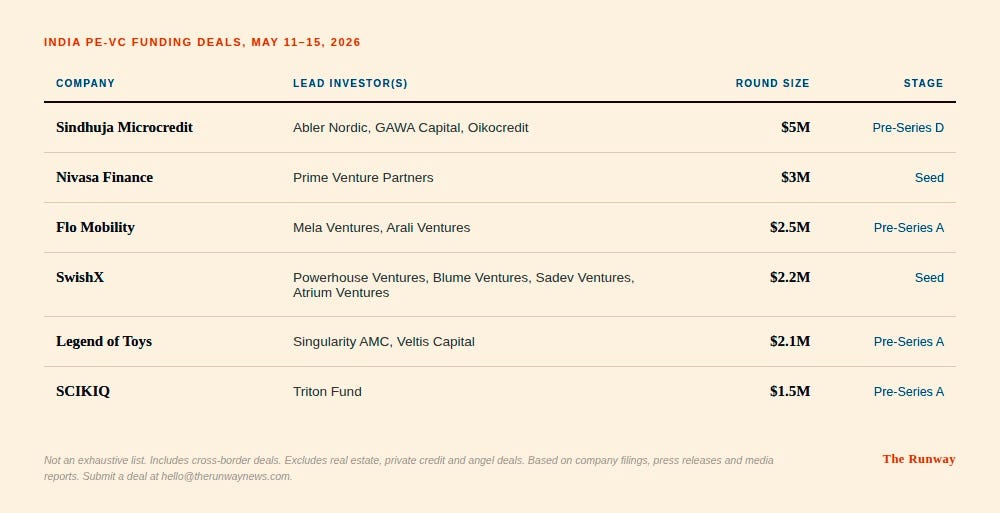
Sub $1 million deals: App-based toy subscription startup The EleFant raised $1 million in a pre-Series A round led by Growth Sense Venture Fund. On-demand smartphone repair service provider Instafix raised $0.78 million in a pre-seed round led by Titan Capital and 8i Ventures. Packaged beverages startup Bombay Banta raised $0.83 million in a pre-Series A round led by DSG Consumer Partners.
Peak XV wasn’t the only homegrown VC that placed bets in the US. Activate, a Mumbai-based AI-focused venture capital firm, joined New York-headquartered voice AI startup ElevenLabs’ recent Series D round.
The undisclosed investment was made through a separate vehicle backed by Activate’s limited partners, the firm said in a statement.
“This partnership is more than just an investment. It’s about creating bridges between global frontier AI companies and India’s early-stage AI ecosystem, helping founders here access the right networks as voice becomes a core interface for them,” it said.
ElevenLabs raised a $500 million Series D in February and was valued at $11 billion.
Submit a deal for The Runway Briefing by replying to this email or write to us at hello@therunwaynews.com.
Recco | Notes on Culture, Craft and the Considered Life
The Sherried Scotch That Macallan Fans Should Know About

In the world of sherried Scotch, a handful of names dominate the conversation. Macallan built an empire on it. Glenfarclas has quietly championed it for decades without the fanfare. Dalmore rides it into the luxury gifting market. GlenDronach sits comfortably in that company — rich, dark, uncompromising — and has just arrived in India.
Founded in 1826, it has built its reputation on the sherried style — one of the more underrated names in single malt globally, and until now, largely absent from Indian shelves.
Brown-Forman has launched the full range in Mumbai — the 12, 15, and 18-year-old expressions, all matured in Pedro Ximénez and Oloroso casks from Spain. The 12-year-old starts at around ₹9,000 in Maharashtra.
The consumer this is aimed at has been around the single malt world long enough to want something with more weight to it. For anyone who has explored the sherried style mostly through Macallan, this is worth a detour. Similar DNA, significantly less of a premium — and an argument, depending on who you ask, for being the more honest expression of the style.
Recco is a column by Murali Menon. Murali has spent a career paying close attention to how things are made, where they come from, and why some of them endure. Every edition, one recommendation: a maker, an object, a place, a practice.
Thank you for reading The Runway. We’d love to get your feedback. Drop us a line at hello@therunwaynews.com or just reply to this email.