


Edition #24. When Indian Premier League (IPL) defending champions Royal Challengers Bengaluru (RCB) kick off the latest season tonight, it won’t be just millions of fans rooting for a win. Wealthy individuals invested in private equity firm Blackstone will also be keeping close watch. Part of their returns are now tied to RCB’s fortunes following the New York-based firm’s recent investment in the franchise – its first in professional sports.
Earlier on Tuesday, Blackstone announced it had joined an investor consortium to acquire Royal Challengers Sports, the entity that owns RCB. The consortium, which includes Aditya Birla Group, The Times of India Group and Bolt Ventures, signed an agreement to buy a 100% stake from United Spirits (USL), a subsidiary of Diageo, in a transaction that valued the franchise at $1.78 billion.
Blackstone, however, is not investing from its traditional funds. The firm is deploying capital from BXPE, short for Blackstone Private Equity Strategies Fund, its perpetual private equity strategy. Unlike Blackstone’s institutional vehicles, which raise capital from pension funds, endowments and sovereign wealth funds, BXPE draws from wealthy individuals. Investors subscribe monthly and redeem their holdings through periodic redemption windows.
Institutional investors or limited partners in traditional, close-ended Blackstone funds would have a fixed timeline – typically ten years – within which the fund must deploy capital, build value and return money. In a perpetual or evergreen structure such as BXPE, capital is recycled into new deals when positions are realised, creating a perpetual investment cycle. The clock never runs out. In the context of the RCB deal, that structure suits Blackstone well.
A cricket franchise is not a buyout target with a conventional exit path. There’s no obvious strategic buyer waiting to pay a higher multiple. The universe of buyers is limited by cricket governing board BCCI’s approval requirements and the political economy of Indian cricket ownership. There’s also no imminent IPO runway. Sports franchises are valued on sentiment, broadcast rights, league performance and the willingness of the next buyer to pay a higher price.
All of this makes the investment, from the standpoint of Blackstone’s retail investors, risky and unpredictable but not irrational.
None of the investors in the consortium are naive buyers. There are only ten IPL franchises and owning one of them, let alone one of the top three by brand value, is not an opportunity that comes around often. The franchise’s underlying financials, however, deserve scrutiny. Royal Challengers Sports declared profits at Rs 140 crore on revenues of Rs 504 crore in FY25 – down from FY24 on account of a shorter playing season. It is a largely illiquid asset, acquired at a record multiple, with a majority of its revenues dependent on a plateauing rights cycle, and whose most important brand attribute is tied to a 37-year-old cricketer preparing to retire.
Also this week:
Healthcare investments-focused Somerset Indus Capital Partners raised $288 million for Fund III, exceeding the targeted $250 million.
Early stage investor Pentathlon Ventures, which targets B2B technology ventures, closed Fund II at Rs 255 crore ($26.8 million).
Manipal Health filed for a $1.17 billion IPO. The offering comprises a fresh issue to raise $852.2 million and an offer for sale by existing investors including Temasek Holdings and TPG.
The Week in Deals
Rocketlane’s Series C; Swish, Fullife Among Consumer Bets
Insight Partners backed a repositioned AI play. Premji Invest made its second pure-play US investment of the month. A91 Partners led a cross-border technology bet. Consumer businesses from fitness and kidswear to wellness and quick food delivery found private capital across stages this week.
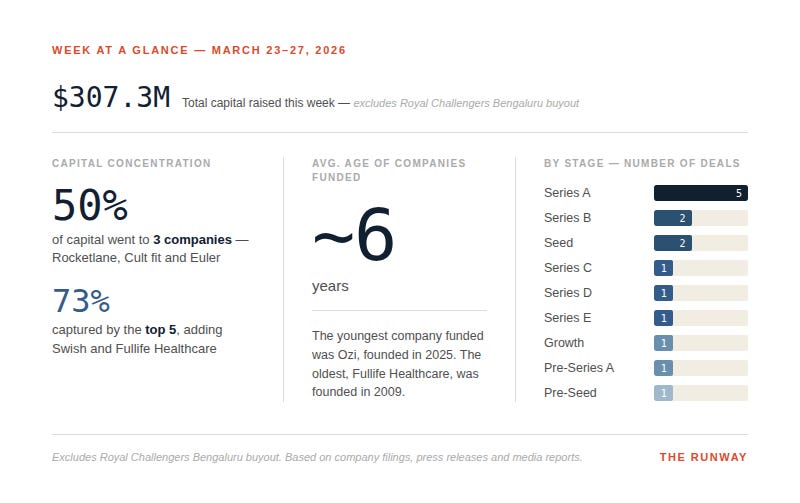
Rocketlane raised $60 million in a Series C round led by Insight Partners. The round takes the total capital raised by the San Francisco and Chennai based startup to $105 million.
Rocketlane started as a SaaS-based professional services automation platform but has since repositioned itself as an AI-led company.
Earlier this month it launched Nitro, billed as the industry’s first agentic execution platform for professional service teams.
Earlier backers in the company include Z47, 8VC and Nexus Venture Partners.
Doss, a San Francisco-based startup building an AI-native operations cloud for enterprises, raised a $55 million Series B round led by Premji Invest and Madrona. The deal marks Premji Invest’s second major bet in the US technology market this month. Earlier, it led a $450 million Series A round in Palo Alto-based industrial robotics startup Rhoda AI.
Cult.fit raised $47 million in a follow-on funding round from Temasek Holdings, Entrackr reported citing regulatory filings. The round values the Bengaluru-based fitness services company at $1.4 billion, the report said.
Euler Motors raised Rs 437.5 crore (over $46 million) in a Series E round led by Lightrock. Hero MotoCorp and Blume Ventures were returning investors in the round.
In February, Hero Motocorp said in a regulatory filing that it was investing Rs 275 crore ($30 million) in Euler “in one or more tranches consisting of a mix of primary and secondary investment,” in a Series E round, raising its stake from 34.1% to 36%.
The Delhi-based commercial electric vehicles maker also raised Rs 250 crore in venture debt from Blacksoil, Trifecta Capital, Innoven Capital and Alteria Capital, alongside the Series E round announced this week.
Swish, a Bangalore-based quick food delivery startup, raised $38 million from hedge fund Hara Global Capital Management and Bain Capital Ventures. Existing investor Accel participated in the round along with venture debt firms Alteria Capital and Stride Ventures.
Fullife Healthcare raised $31.9 million from Elev8 Venture Partners. The investment in the Mumbai-based health and wellness products company marks Elev8’s first in the D2C space and the sixth from its maiden fund raised last year.
Deccan AI raised $25 million in a Series A round led by A91 Partners. Susquehanna International Group joined the round as a new investor while existing investor Prosus Ventures participated. The San Francisco-based startup, which has extensive operations in Hyderabad, operates in the AI post-training arena and competes with the likes of Mercor and Turing.
Other deals this week:
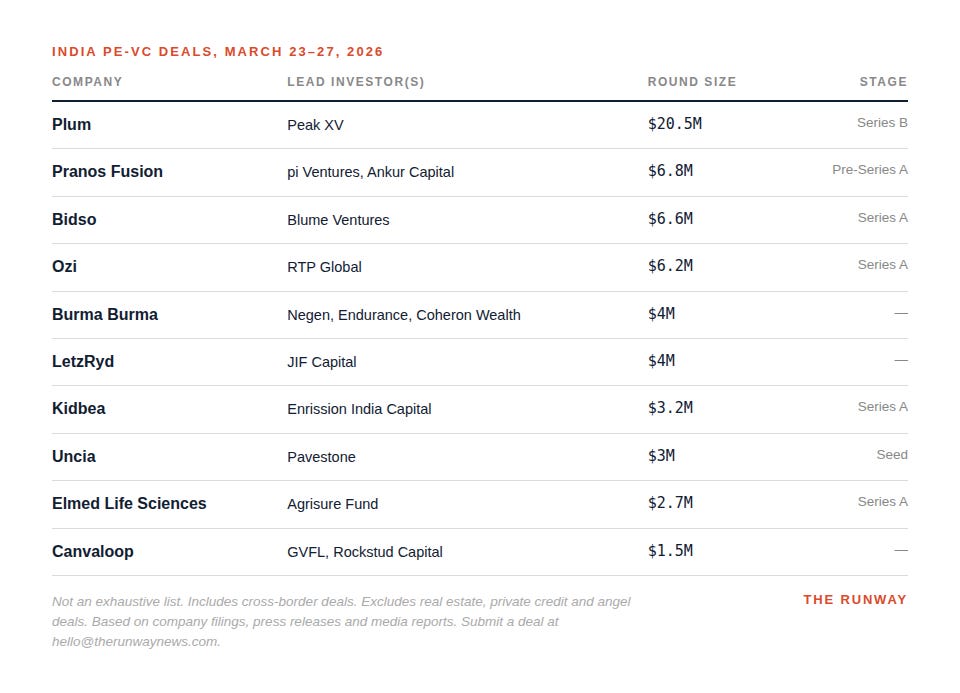
Sub-$1 million deals: Hyderabad-based no-code manufacturing process automation platform Workroom Automation raised $0.6 million in a seed round led by Equirus Innovate X Fund. Ghaziabad-based B2B marketplace for apparel retailers Thread Factory raised $0.1 million from AJVC.
Submit a deal for The Runway Briefing by replying to this email or write to us at hello@therunwaynews.com.
Recco | Notes on Culture, Craft and the Considered Life
A Quiet Expansion on the Mandovi

Since its launch in 2018, The Postcard Hotel (Titan Capital was an early investor) has become one of the more interesting boutique luxury chains to watch in India. Founded by Kapil Chopra, the former president of Oberoi Hotels, it began with a simple departure from hotel orthodoxy: no fixed check-in or check-out times, and breakfast whenever you wake up.
Over the past eight years, Chopra has added properties in quiet locations —Leh, Gir, Assam, Kochi and coastal Karnataka, along with outposts in Bhutan and Sri Lanka. In Goa alone, the group now operates five properties, each small in scale and quietly positioned away from the state’s busier circuits.
The latest addition, The Postcard on the Mandovi, sits along the river with 17 rooms, each with a private balcony. The Mandovi Suite includes a separate living area, two bedrooms and a pantry. There is a spa on site, the menu leans into Goan classics, and Panjim’s old quarters and better-known restaurants are a short drive away.
Across properties, the formula remains steady: no buffets, limited inventory, privacy as default. If you’re heading to Goa this summer and want something calmer than the usual coastal churn, Mandovi is worth considering.
Recco is a column by Murali Menon. Murali has spent a career paying close attention to how things are made, where they come from, and why some of them endure. Every edition, one recommendation: a maker, an object, a place, a practice.
Thank you for reading The Runway. We’d love to get your feedback. Drop us a line at hello@therunwaynews.com or just reply to this email.