



Edition #21. Three IPOs from private equity-backed companies have tested India’s public market appetite in recent weeks. Fractal Analytics arrived with an enterprise AI narrative and listed at a nearly 3% discount to its offer price. Clean Max Enviro Energy Solutions, with its renewable energy pitch, listed at a 9% discount. The third, Sedemac Mechatronics, a deeptech startup born inside an IIT Bombay incubator lab, slated to list on the bourses early next week, is expected to fare better.
Sedemac came to the market entirely on an OFS (offer-for-sale) basis, enabling existing private equity and venture capital investors to monetise positions built over years and in some cases, months. The Pune-based company’s Rs 1,087 crore offering, set at a price band of Rs 1,287-Rs 1352 per share, was subscribed 2.68 times – roughly in line with Fractal’s 2.81x and well ahead of Clean Max’s sub-1x. All three saw weak retail participation.
Where Sedemac pulled ahead was on institutional demand. QIBs (qualified institutional buyers) covered the offering 8.46 times against Fractal’s 4.41x and Clean Max’s 2.99x.
Compared to Fractal and Clean Max, Sedemac is a different kind of company. It makes electronic control units – components that power automotive engines. It’s a below-the-radar, sophisticated, deep technology business that’s been compounding annual revenues at approximately 25%, serving clients such as TVS Motors and Bajaj Auto at home and several more overseas.
Let’s break down the investor story that’s unfolding behind the OFS.
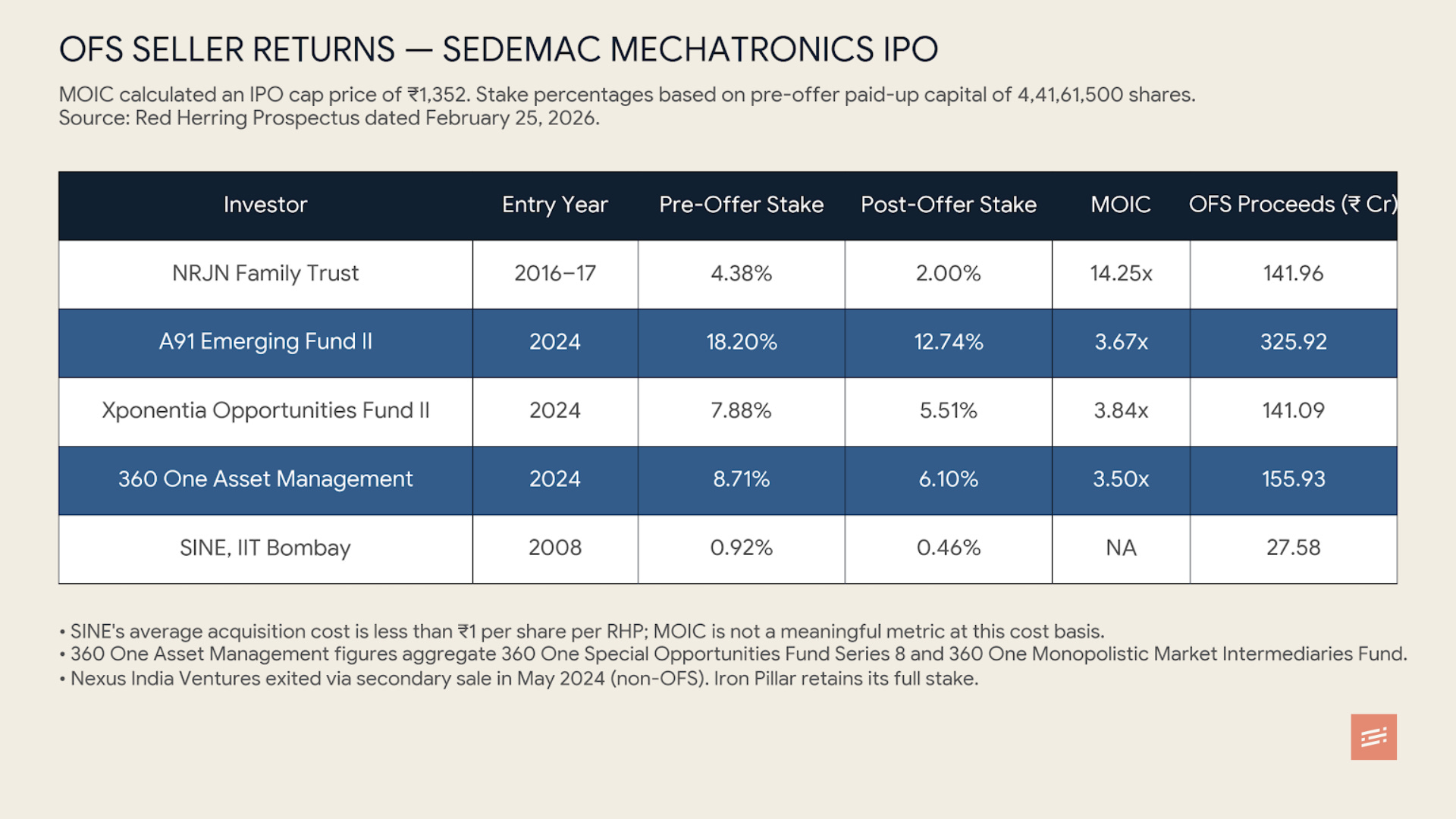
The oldest and most patient capital, apart from IIT Bombay, is the NRJN Family Trust, an investment firm set up by Infosys co-founder Nandan Nilekani. It first backed Sedemac in 2016, predating the current enthusiasm for deeptech in India. It’s selling a little over a 2% stake that is valued at about Rs 142 crore, earning a return multiple of over 14x.
Private equity firms A91 Partners, Xponentia Capital Partners and 360 One Asset, who entered the company just about two years ago, are also slated to walk away with significant gains. All three became investors via secondary transactions in 2024 that saw early investor Nexus Venture Partners exit. At the IPO cap price, their returns from partial stake sales range between 3.5x and 3.8x.
IIT Bombay incubator SINE is also in line for an outsized return. It received shares from the founding team in the early years at less than a rupee per share and is selling half of its 0.92% stake through the OFS. That works out to approximately Rs 28 crore at the IPO cap price. For an academic institution, the return spells a meaningful commercial validation of what university-linked incubation can achieve.
Sedemac’s public market outing comes at a time when the world is grappling with geopolitical uncertainty on account of the US-Israel strikes on Iran. When 2026 began, it was widely expected to be another promising year for PE-backed listings in India. For now, the immediate future for the IPO pipeline looks less certain than it did a month ago.
Sedemac’s performance becomes just a bit more interesting in that context.
Fractal and Clean Max carried the weight of the macro positioning into their listings and found that public market investors, already wary of elevated private valuations, were not prepared to pay for narrative alone. That’s not to say that the two companies have not built defensible businesses over their lifetimes. But, in a market that may be entering a more risk-averse phase, a business like Sedemac that wasn’t carried by a macro tailwind may be just the kind of story institutional, and eventually retail investors, will choose to get behind.
The Week in Deals
Ayurveda Makes a Splash
It’s been a slow week for dealmaking but consumer businesses stayed on top of the charts. Also, a new health-tech startup to watch.
SFO Technologies | PE
The electronics manufacturing services and original design manufacturing solutions company raised $82 million in a growth round led by mid-market focused private equity firms Trident Growth Partners and Amicus Capital Partners. Anicut Continuum Equity Fund and HDFC AMC Select AIF FoF-I participated in the round. Part of Kochi-based conglomerate NeST Group, SFO Technologies caters to clients across aerospace, communications, defence and transportation.
Rozana | VC
The rural ecommerce platform raised a Rs 290 crore ($31.6 million) Series B round led by existing investor Bertelsmann India Investments. Fireside Ventures, also an existing investor, Spark Growth Ventures, Bikaji Family Office and FE Securities participated in the round. The Delhi-based company connects consumers, primarily in Uttar Pradesh and Haryana, with retailers through an omnichannel platform that includes an app and offline retail stores and distribution centres. India’s rural consumption market, Bertelsmann said in a statement, is valued at over $2 trillion.
Inamo | VC
Prime Venture Partners led a $8 million Series A round in Inamo, which offers quick commerce companies a full-stack technology platform to optimise supply chains. Shastra VC, Antler India and Gemba Capital joined the round. The Mumbai based startup “has expanded its presence to six metro cities, processing over 1.8 million orders a month with ARR increasing more than 10x over the past 10 months,” Prime Venture Partners said in a social media post.
RAS Beauty | VC
The ‘farm-to-face’ skincare brand raised $7.5 million in a Series B round led by Dabur Ventures. Existing investor Unilever Ventures joined the round. Dabur Ventures invested Rs 60 crore (about $6.5 million) in the round, Dabur India said in a regulatory filing.
“This is the first investment from Dabur Ventures, which was launched in October 2025… to acquire stakes in high potential, new-age D2C businesses…” it said in the filing.
Founded by sisters Shubhika Jain and Suramya Jain, and their mother Sangeeta Jain, RAS Beauty is a Raipur-based company founded in 2017.
Forest Essentials | M&A
The Estée Lauder Companies acquired an additional 51% stake in ayurvedic personal care company Forest Essentials. Financial terms of the transaction were not disclosed. The deal converts an 18-year partnership into full ownership. Estée Lauder first picked up a stake in Forest Essentials in 2008 and increased it to 49% in 2020.
“This next phase of (the) partnership reflects our long-term commitment to India — one of our largest and most significant emerging markets — and our conviction in the global resonance of this remarkable brand. Together, our ambition is clear: to further strengthen the brand’s leadership at home while thoughtfully introducing it to a global audience,” The Estée Lauder Companies president and CEO Stéphane de La Faverie said in a statement.
Mira Kulkarni, who founded the company in 2000, will continue to oversee the business with her son Samrath Bedi. The Delhi-based company, which has never raised capital from financial investors, follows an omnichannel retail strategy which includes nearly 200 offline stores.
Sub $5 million deals: EV startup Bounce raised $5 million in an internal round from existing investors Accel, B Capital and Qualcomm Ventures. Cent, a new health-tech startup from Practo founder Shashank ND, raised a reported $5 million round led by One Flow Holdings. Generative AI semiconductor solutions startup Turiyam AI raised $4 million in a round led by Ankur Capital. AI-led conversational CRM and automation platform Cheerio raised $0.8 million in a round led by Artha Venture.
Not an exhaustive list. Based on company filings, press releases and media reports. Submit a deal at hello@therunwaynews.com.
Quickly before we go
Boat co-founder Aman Gupta announced a new venture called Offbeat Studios in a social media post. Further details were not available. The move came months after Gupta stepped down from his operating role as CMO at the Warburg Pincus backed electronics company.
Gupta founded Boat in 2014 with Sameer Mehta, who also stepped down in September last year from the CEO role. The leadership changes came amidst continuing uncertainty around the company’s proposed public market listing.
Imagine Marketing, the Mumbai based company that owns the Boat brand, filed draft IPO papers with SEBI as early as January 2022, aiming to raise Rs 2,000 crore. In October last year, it filed updated draft IPO papers with the markets regulator to raise Rs 1,500 crore of which Rs 1,000 crore constitutes the offer-for-sale portion. Selling stakeholders include Warburg Pincus, Fireside Ventures and Qualcomm Ventures. Boat raised $100 million from Warburg Pincus in 2021. Fireside Ventures entered the company in 2018 and currently owns a 3.28% stake. Qualcomm Ventures first invested in the company in 2021.
Thank you for reading The Runway. We’d love to get your feedback. Drop us a line at hello@therunwaynews.com or just reply to this email.