


Welcome Edition #3. This week we dive into what drove capital flows in India’s venture capital market last month. With Diwali around the corner, a good tipple is in order. Pursuits curates a selection of fine whiskies you may want to add to your portfolio!
Tell us what you liked (didn’t like) about this edition. We’d love to get your ideas and suggestions to shape future editions.
Lede
India’s VCs Balance Global AI with Local Bets

A rundown of venture capital deals in India is never dull.
While AI dominated September’s deal activity, it shared space with a pickle brand, non-toxic cookware, quick-commerce pharmacies, zero-inventory fresh produce, fintech, ecommerce, and ayurvedic wellness. It’s a reminder of how distinct and delightfully unpredictable India’s venture landscape can be.
The diversity underscores the sheer breadth of opportunity this market offers investors. Yet, it also highlights how nascent India’s deeptech ecosystem remains, even as Silicon Valley continues to stretch the boundaries of what technology can do.
Here’s a look at the key themes that defined India-focused and India-linked venture capital dealmaking in September.
Capital concentration
Of the 76 deals (excluding those backed by angels, accelerators, and incubators) that raised a cumulative $860 million in September, 10 accounted for nearly 57% of the total. The month’s largest deal was a $83 million Series G raised by B2B construction materials marketplace Infra.Market from returning investors including NKSquared (the Zerodha founders’ family office), Accel, and Nexus Venture Partners.
Notably, seven out of the 76 deals struck by Indian venture capitalists sit in the US–India deeptech/AI corridor and accounted for 23.6% of the capital raised. Leading the pack was San Francisco based product analytics startup PostHog which raised $75 million in a Series E round led by Peak XV Partners.
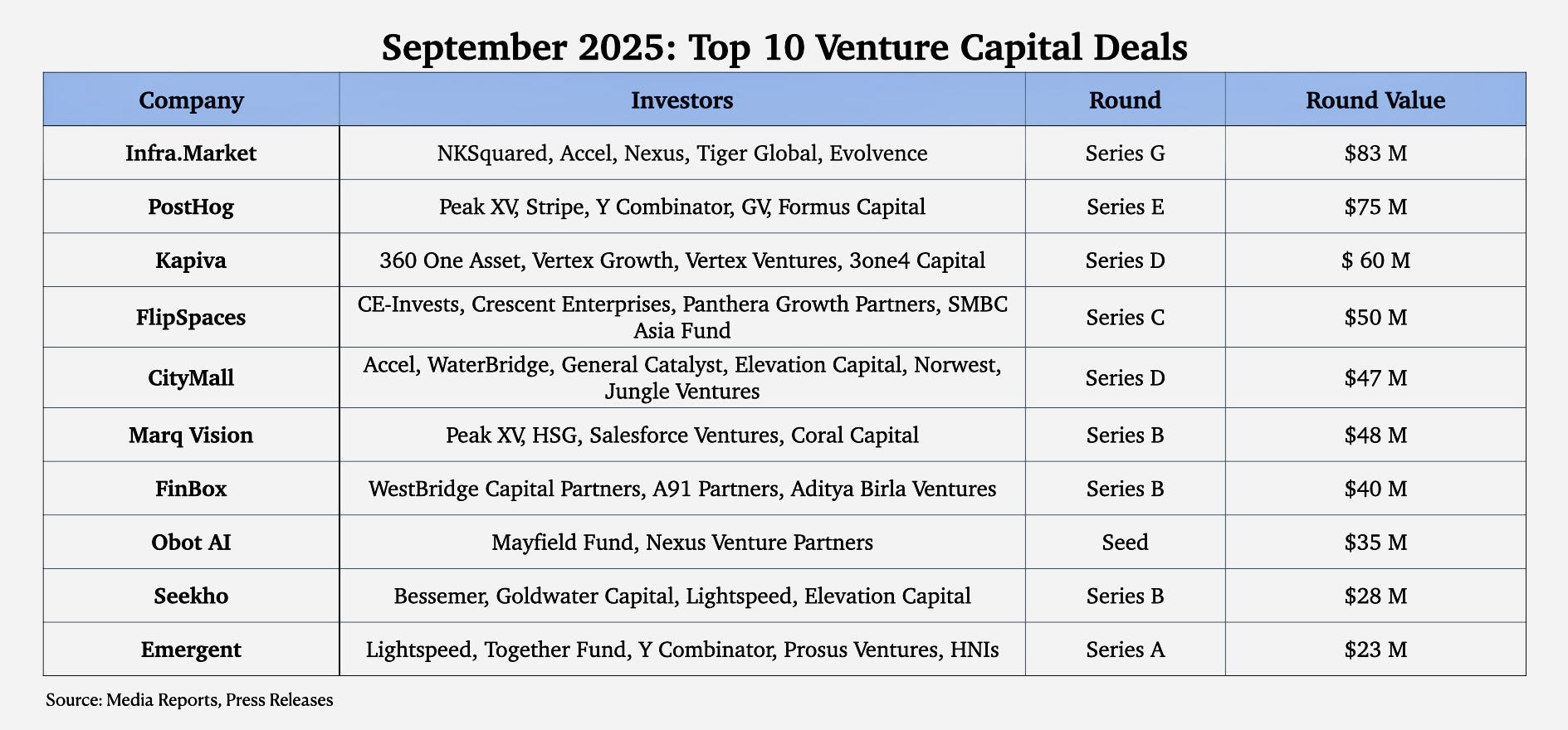
Seed and Series A deals far outnumbered later rounds, signalling that while investors remain comfortable making small bets on new ideas, companies in the middle stages (Series B and C) – which may have achieved product-market fit but are yet to demonstrate consistent, repeatable margins – still face an uphill task in justifying growth cheques. This trend continues from the last two years, when a downturn in the funding market compelled investors to reserve capital for companies that could show a clear path to profitable growth.
The caution mirrors the broader market sentiment. While 2025 began on a strong note with overall PE/VC investments touching $9.97 billion, geopolitical factors — notably global tariff wars — have dampened investor confidence. In the April–June quarter, investments plunged to $5.35 billion and remained largely flat in the July–September quarter at $5.67 billion (Source: Venture Intelligence).
It is unlikely that the numbers will improve significantly in the current quarter.
The AI current and the global hedge

The AI current running through September was unmistakable. But there was a dual strategy in play.
Peak XV’s dealmaking in September emphasised its stated global operating thesis. Besides PostHog, it led a $48 million Series B in Los Angeles based brand protection startup Marq Vision and a $15 million Series A in San Francisco based sales coaching startup Hyperbound AI. Back home, the AI theme continued but a bit differently. Ahmedabad based Ignosis, which raised a $4 million pre-Series A round led by Peak XV, is a financial data intelligence platform for banks and financial institutions that leverages AI-powered analytics. Another recent deal was Bangalore based OnFinance – Peak XV led a $4.2 million pre-Series A – which harnesses generative AI for the automation of regulatory compliance and risk management processes in the financial services sector.
For India’s largest homegrown venture capital firm (by AUM), the dual approach is a strategic global AI hedge. With most foundational AI infrastructure and developer tools originating in the US, Peak XV’s overseas bets secure access to superior technology and category knowledge that can eventually be applied to its portfolio here.
It’s not a unique strategy. Nexus Venture Partners has been investing in the US-India corridor since inception. In September, it co-led a $35 million seed round in Cupertino, California-based Obot AI, which is building an open source platform to enable enterprises to securely scale AI solutions; and led a $2.2 million seed round in Sunnyvale, California based enterprise security startup Aurva. Z47 (formerly Matrix Partners India) co-led a $5.5 million seed round in AI identity infrastructure startup Scalekit. Together Fund, founded five years ago to back cross-border companies, joined a $23 million Series A round in no-code app development platform Emergent.
When it comes to bets in India, the AI thesis becomes a bit fuzzy. Last month, Z47 participated in a $7 million seed round in Oolka, a fintech that’s deploying AI for credit management. Short form learning platform Seekho raised $28 million in a Series B round led by Bessemer Venture Partners. It claims to be building out AI-based learning experiences. Interior design platform Flipspaces, which is investing in agentic AI tools for greater process efficiency, raised a $50 million Series C round led by CE-Invests. FinBox, which is building AI-native credit infrastructure for banks and NBFCs, raised $40 million in a Series B round led by WestBridge Capital Partners. And Rocket, a no-code/low-code platform for building apps, raised a $15 million seed round from Salesforce Ventures, Accel and Together Fund.
The deals above are a partial representation of the AI-related investments in India last month. It may be argued that AI has become the default technology layer for businesses across the spectrum. For investors, the thesis appears to be “use AI to improve unit economics” whether by automating underwriting in fintech or lowering customer acquisition costs in ecommerce and marketplaces.
De-risking with consumer and retail
Coming back to pickles, consumer and retail startups remained top draw for venture capitalists. Driven by India’s expanding urban and middle-class consumption, investors favoured the sector as a de-risking strategy against global macro volatility.
Here are some notable deal trends from the month:
Kapiva, the ayurvedic wellness products company, secured a $60 million Series D round led by 360 One Asset – validation of its traditional health products proposition adapted to modern D2C distribution.
EcoSoul, which makes sustainable home-use products, raised $20 million led by Accel, while ice cream maker Hocco Foods raised $13 million from Sauce VC, reinforcing confidence in established brands that cater to non-discretionary or aspirational domestic consumption.
Online commerce models are evolving and investors are dialing in. Value commerce startup CityMall picked up a $47 million Series D cheque led by Accel while members-only quick commerce platform FirstClub raised a $23 million Series A round from returning investors including Accel and RTP Global. Online pharmacy Platinum Rx raised a $6 million Series A led by Stellaris Venture Partners and quick medicine delivery app Plazza raised a $1.4 million seed round led by All In Capital.
Kitchenware and cookware is a fast-growing emerging emerging category. Non-toxic cookware maker Ember raised a $3.2 million seed round led by high networth individuals and family offices while P-Tal raised a $3 million from VC Grid and Rainmatter among others.
A bunch of micro-brands also found capital, including pickle brand FarmDidi ($0.7 million), maternity clothing brand House of Zelena ( $0.7 million), and wellness brand Zanskar ($0.3 million).
HNIs proliferate seed, pre-Series A deals
Across the 76 deals from September, high networth individuals (HNI) and family offices played a central role, co-investing in large, mid-sized and micro deals across the stage and sector spectrum. Over the past few years, this constituency has become increasingly prominent in India’s venture capital ecosystem, often preferring to co-invest rather than allocate capital to venture capital funds.
Their participation was crucial for driving capital flows during the two-year downturn that all but crippled the local venture capital market.
September saw these investors become particularly active in the seed and pre-Series A stages (Plazza, Scalekit, P-Tal, Oolka, Ignosis, Lucira). This domestic money is less reactive to global monetary policy shifts and FPI volatility, providing a stable source of capital for the early-stage funnel.
Additionally, the presence of corporate venture capital – Salesforce Ventures backing Rocket and Razorpay Ventures in Ignosis – underscores the competitive nature of the market.
What to expect in Q4
As 2025 enters its final stretch, caution and flight to quality will continue to prevail even as capital continues to flow. But the diversity of the Indian market and its technology-led innovation cycle define why it remains one of the most investable venture markets in the world.
From a limited partner standpoint, there are a few takeaways. The structurally diverse deal flow across AI and deeptech, fintech, consumer and sustainability insulates the ecosystem from sectoral shocks. As homegrown venture capital firms extend to global markets, limited partners have an opportunity to capture both domestic growth and global technology leverage.
And finally, with Indian family offices writing larger cheques, the ecosystem is much less dependent on cyclical foreign inflows.
Recco | Notes on Culture, Craft, and the Considered Life
3 Whiskies For The Festive Season

A few recent releases offer good reason to restock the bar this festive season.
William Grant & Sons continues to strengthen its leadership in India’s luxury whisky segment with the Glenfiddich 16-Year-Old, created to mark the distillery’s partnership with the Aston Martin Formula One team.
Matured in American oak wine casks, new American barrels, and second-fill bourbon casks, it reflects the distillery’s focus on precision and balance, with restrained sweetness and echoes of maple, ginger, and fresh fruit.
From Goa, the highly regarded Indian single malt maker Paul John has introduced Bengaluru Habba, a 192-bottle Duty Free exclusive bottled at 56.4 % ABV. Distilled and aged in Goa’s tropical climate, it combines the brand’s signature richness with a faint wisp of peat and a long, clean finish.
And from Jammu, GianChand’s new single malts — Adambaraa (unpeated) and Manshaa (peated) — recently picked up awards in Las Vegas and Germany for their balance of smoke, spice, and citrus.
Together, they make a compelling case for discovery — and for keeping one’s bar as considered as one’s portfolio.
Happy Diwali!
Thank you for reading The Runway. We’d love to get your feedback. Drop us a line and stay tuned for the next edition.