


Hello and welcome back. It’s been quite the week for all things AI. Anthropic is now valued at nearly $1 trillion. As the global AI race gets fiercer, it’s been relatively quieter here at home. In Edition #33 we’re talking about the direction early stage investors in India are taking to craft the best return outcomes for AI-related bets.
New to the The Runway? Subscribe for a comprehensive view of the deals, strategies and people shaping private equity and venture capital in India every week. We’re also on LinkedIn and WhatsApp if you want to keep track of updates on future editions.
Early Stage Capital’s Dual Strategy for AI

Mumbai Tech Week is underway this weekend. If you’ve attended the conference in the past, you know that it’s a whirlwind of curated conversations, startup pitches and tons of networking if you can manage to navigate the chaos. The theme this year is India: AI in Action. At a time when global generative AI giants Anthropic and OpenAI are engaged in a frenzied valuation race – Anthropic just raced past OpenAI to touch nearly $1 trillion – India is making a bid to emerge as the next laboratory for AI at scale.
India has the data volumes, engineering density and the cost structures that make it an attractive deployment market for AI applications. The strongest argument for the country’s AI future is that it is building the physical infrastructure – data centres, servers, power capacity – that AI needs to run. Government and industry estimates put its installed data centre capacity at 9-10 GW by 2030.
Not everyone is persuaded. Indian equities could be headed for their first annual decline in over a decade, a Reuters poll of equity analysts found. India’s limited exposure to trade led by global AI innovation and a widening current account deficit in the wake of the West Asia crisis is leading foreign institutional investors to pull out capital.
Even GCCs (global capability centers), are undergoing a rethink on hiring. India’s appeal for GCCs has always rested on large pools of English-speaking engineers willing to run complex processes at a fraction of the cost of doing so in the US or Europe. Now the proliferation of AI is reshaping many of those jobs and there’s a real question on whether workforces can upskill fast enough to absorb talent at the scale and pace seen over the past couple of decades.
Against that backdrop, the role of early stage capital and what it backs becomes important. In recent weeks, a number of specialist funds targeting AI and deep tech investments have entered the market, in line with a steady flow of similar capital over the past couple of years.
The latest is F2A, short for Fundamentum Frontier Advisors, a platform launched by Fundamentum Partnership co-founder Ashish Kumar. Its first fund aims to raise Rs 2,000 crore ($209 million) with Fundamentum Partnership co-founder Nandan Nilekani as anchor investor. Additionally, it will facilitate up to Rs 1,000 crore ($104 million) in parallel co-investments.
Other new funds currently on the road include Piper Serica, which launched the Bharat Tech Fund with a Rs 800 crore ($83 million) target corpus to back companies across semiconductors, AI and spacetech; Shastra VC is raising a $100 million fund to back early stage startups in AI, spacetech, defence and climate science; and Speciale Invest, which raised a Rs 600 crore early stage fund last year, is currently on the road for a Rs 1,400 crore (about $150 million) growth fund.
India-born deeptech startups attracted $2.1 billion across 289 deals in 2025, with AI funding rising 58% year-on-year to $1.22 billion, according to the India Deep Tech Alliance’s AI and Deep Tech Investments Landscape report.
But Indian venture capitalists are also increasingly putting capital to work overseas, primarily in the US or within the US-India corridor. In recent months Peak XV Partners backed Vapi, Exaforce, Luminai, Archil and Clouted. Nexus Venture Partners joined rounds in Gumloop, Triomics and OpenObserve. A91 Partners led a round in Deccan AI; Elevation Capital backed Portkey and Z47 co-led a round in Coral.
Premji Invest leading a $450 million Series A in Rhoda AI and co-leading a $55 million Series B in Doss are the most prominent examples of Indian institutional capital chasing pureplay US opportunities this year.
Early stage capital clearly sees value in underwriting the applications opportunity in India. But equally, it sees value in hedging, placing bets in the US where the foundational layer of the AI stack is being built. Incidentally, many of those bets involve Indian-origin founders who started their careers here before moving out to build overseas.
The Week in Deals
Biotech, B2B Quick Commerce Land Series A Cheques
Large Series A rounds in biotech, B2B quick commerce, precision manufacturing propped up the week. Nexus Venture Partners went shopping overseas this week, joining later stage investment rounds in two US-based companies.
Embio raised growth capital from private equity firm True North, which acquired a minority stake in the Mumbai-based active pharmaceuticals ingredients maker. True North invested from Fund VII, marking the fund’s third investment and the first in the pharmaceuticals sector, it said in a statement. The financial details of the transaction were not disclosed. The Economic Times reported the deal size at $50 million.
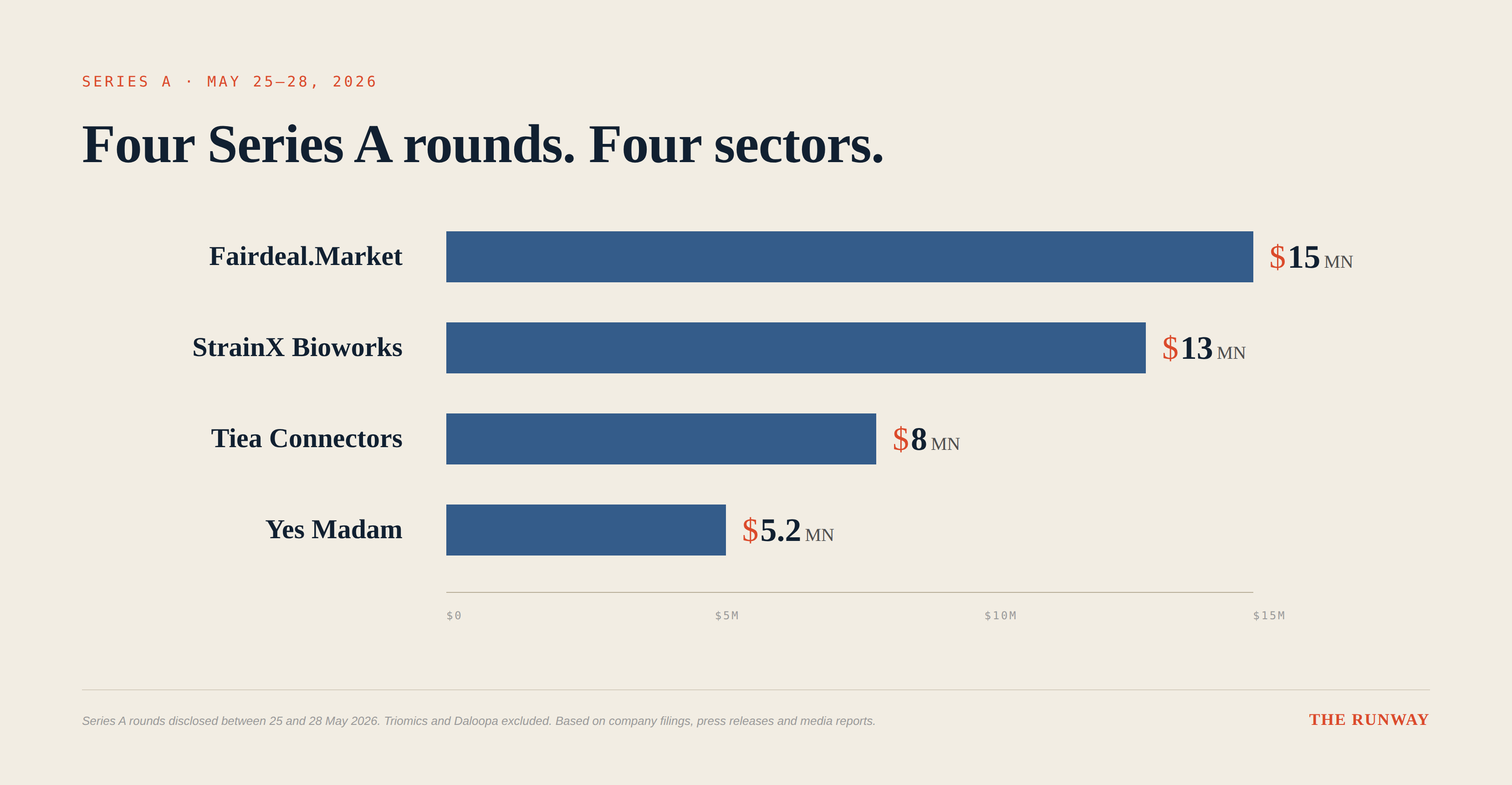
Fairdeal Market raised $15 million in a Series A round led by Bertelsmann India Investments. WaterBridge Ventures and Incubate Fund Asia were returning investors in the round. Gurugram-based Fairdeal Market is a B2B quick commerce platform that enables neighbourhood retail stores or kiranas to source FMCG products at wholesale prices within 60 minutes. It employs an inventory-owned, dark-store-led operating model to deliver over 1,000 SKUs to kiranas and has scaled to 20,000-plus active retailers across Delhi NCR, Bertelsmann said in a statement.
StrainX Bioworks raised $13 million in a Series A round led by Prime Venture Partners and Leo Capital. Good Startup, Sparrow Capital, Sun Icon Ventures, Dhoka Ventures and WindT Angels co-invested. The Bangalore-based startup is building a precision fermentation platform to produce alternative proteins and high-value biomolecules for application in food, nutrition and cosmetics. The deal marks Prime Venture Partners’ first in the biotech sector.
Tiea Connectors secured $8 million in a Series A round led by IvyCap Ventures, with participation from Jamwant Ventures and 8X Ventures. The Bengaluru-based company designs and manufactures high-performance connectors, precision contacts, and advanced connectivity solutions for OEMs in automotives, EVs and defence.
Abcoffee raised $6.4 million in a pre-Series B round led by Kliff Ventures, the consumer sector focused venture capital firm launched by K Hospitality Corp last week. Hero Enterprise Partner Ventures, Merisis Venture Fund and Stride Ventures joined the round. Mumbai-based Abcoffee sources and retails speciality coffee beverages online and via an offline chain of quick service outlets.
Yes Madam raised $5.2 million in a Series A round from Info Edge Growth Fund. The Noida-based startup provides on-demand salon and spa services at consumer homes and operates offline salons.
Sub $1 million deals: ZeroDrag, a startup that designs and manufactures components for drones, raised $0.7 million from Transition VC.
In offshore deals, Nexus Venture Partners joined Daloopa’s $47 million Series C round, which was led by Brighton Park Capital. Other investors in the round were Squarepoint Capital and Touring Capital. The New York-based company provides AI-led data infrastructure for investment research. Nexus first invested in the company’s seed round in 2019. It also joined Triomics’ $22 million Series B round, which was led by Battery Ventures. Triomics is a New York-based oncology AI company helping cancer centers operationalize complex clinical information.
Submit a deal for The Runway Briefing by replying to this email or write to us at hello@therunwaynews.com.
People Moves
EQT’s New Asia Private Capital Heads
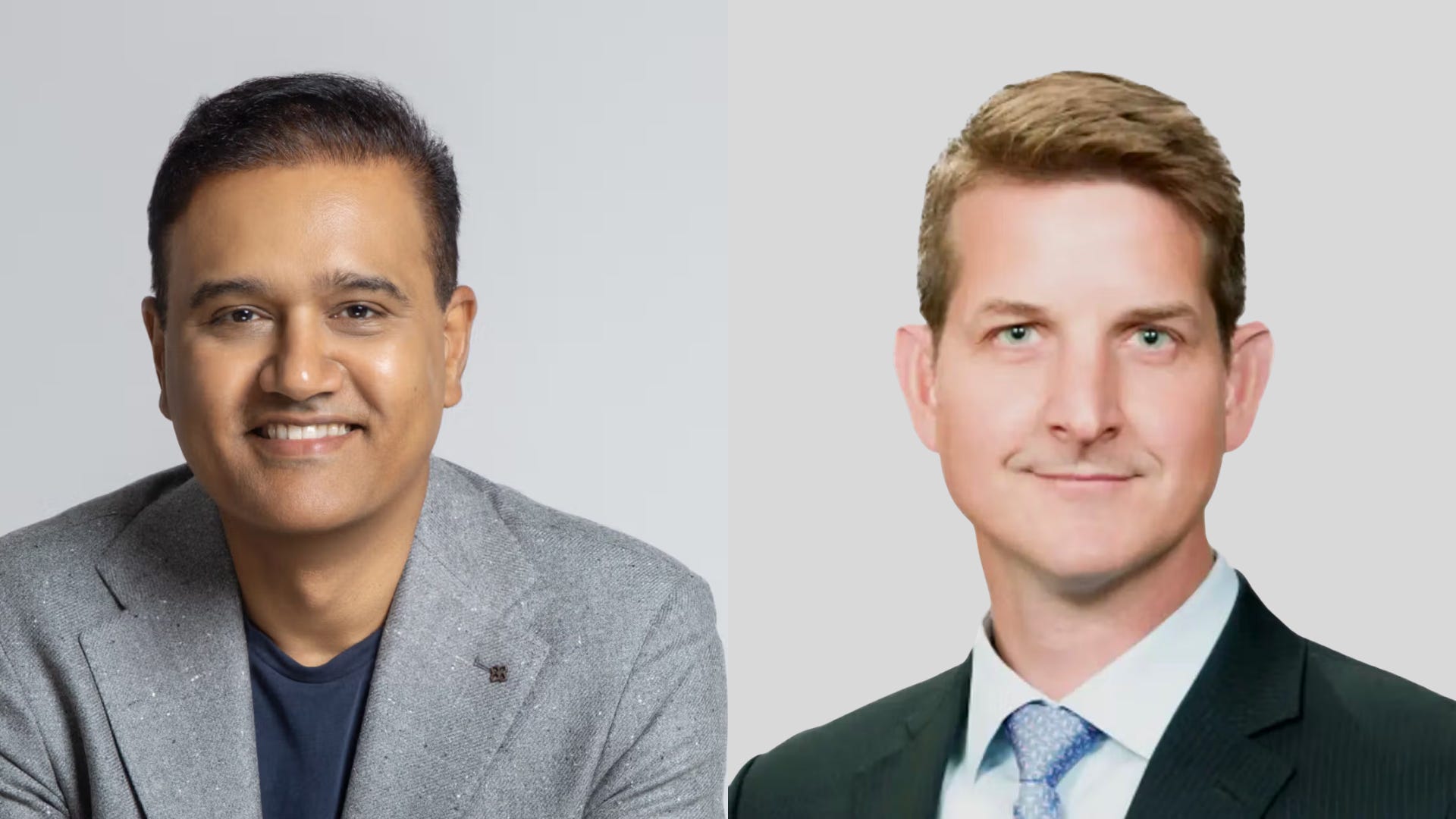
Swedish private equity firm EQT elevated India head Hari Gopalakrishnan to Co-Head of Private Capital Asia. Nicholas Macksey, who led the firm’s mid-market opportunities in Asia, was appointed the other co-head for Asia.
The appointments came in the wake of Jean Eric Salata assuming the role of chairperson at EQT and the raising of a $15 billion Asia-focused buyout fund.
Gopalakrishnan was a founding member of Baring Private Equity Asia, which merged with EQT in 2022.
Recco | Notes on Culture, Craft and the Considered Life
Small Cars, Big Money

It’s after hours on LP day at your firm, and you’re shooting the breeze with an extremely important person. Turns out he’s looking for a gift for an automobile enthusiast friend. Something “different”, as they always say.
So no Porsche Design chronographs, no signed Ayrton Senna helmets, no scale-model Lamborghinis sitting under acrylic covers. Impressing this gentleman is important. So you nod knowingly and point him towards Hedley Studios.
Formerly known as The Little Car Company, Hedley builds officially licensed miniature electric versions of some of the world’s most iconic automobiles. And these are not toys in the Hamleys sense.
We’re talking hand-formed aluminium bodies, bespoke interiors, proper suspension engineering and collaborations with brands like Ferrari, Bugatti, Aston Martin and Bentley. A lot more soul-stirring than Ferrari’s recent Luce-era abstraction.
Its line-up includes the Ferrari Testa Rossa J, the Bugatti Baby II and the Aston Martin DB5 Junior — tiny, driveable electric recreations that cost as much as a luxury sedan. Clients reportedly include Rihanna, David Beckham and A$AP Rocky. Prices start at well over $100,000.
Recco is a column by Murali Menon. Murali has spent a career paying close attention to how things are made, where they come from, and why some of them endure. Every edition, one recommendation: a maker, an object, a place, a practice.
Thank you for reading The Runway. We’d love to get your feedback. Drop us a line at hello@therunwaynews.com or just reply to this email.
This is an exceptional institutional breakdown, Snigdha. The strategic shift toward hedging AI exposure on overseas cap tables hits the absolute core of how we must model long-term state capacity and economic sentiment variance.
From an electoral data perspective, traditional forecasting models often over-index on domestic tech-sector headlines to capture middle-class and white-collar confidence.
On substack.com/@electoralindex, we run demographic survey raking to look at the structural realities beneath the PR. When domestic venture capital actively hedges away from local compute infrastructure toward global deep-tech corridors, it signals a distinct architectural constraint in the domestic high-value job engine. When we adjust sampling weights for this capital dislocation across major technology and urban manufacturing hubs, the data reveals a quiet, non-linear rise in white-collar voter volatility—proving that global venture shifts dictate localized sentiment long before they show up in domestic labor indices.