


Welcome to Edition #5 of The Runway. From luxury and quick commerce to healthcare and AI, October presented a vibrant dealmaking market as the final quarter of 2025 got underway. Dive into our monthly breakdown of private capital flows. AI has become an integral part of the PE-VC narrative. Guest writer Shubham Sharma breaks down what the recent spate of deals mean. Plus, a nod to keeping time in style in Recco.
Lede
Mega Deals Are Back. Almost
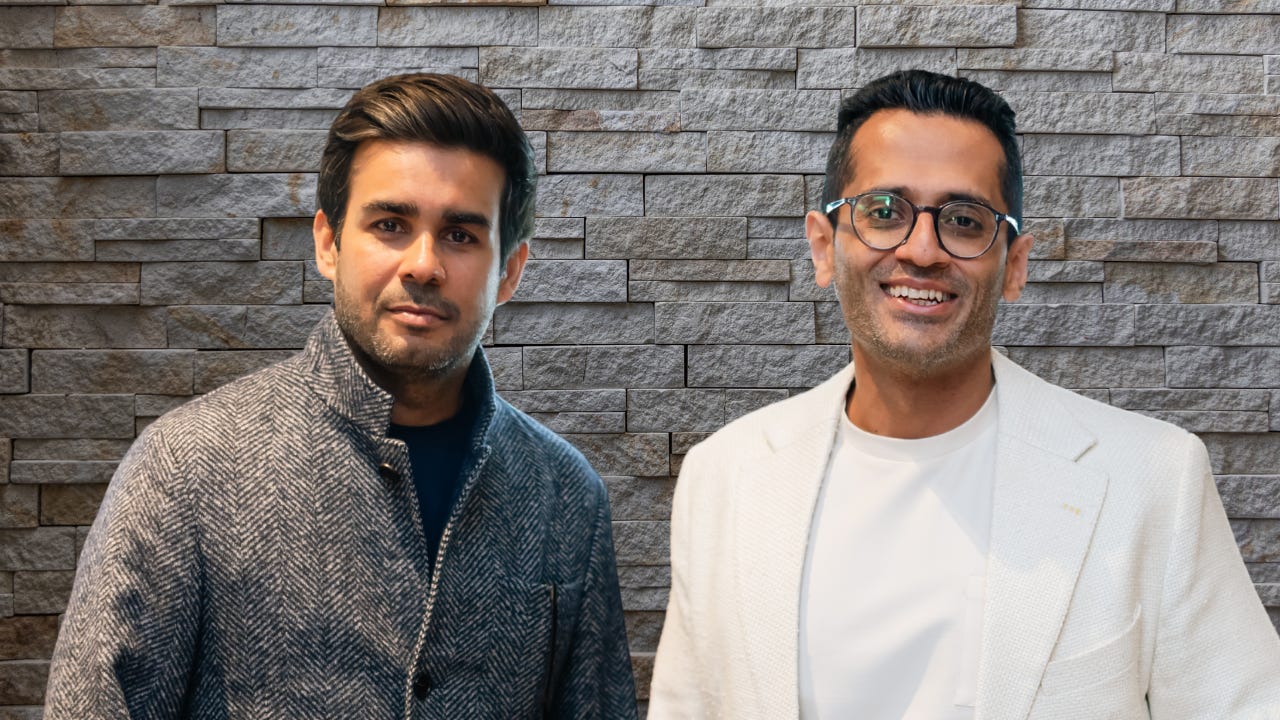
Even a decade ago, the luxury watches market in India was a quiet space. Today, the scene, as they say, is a lot more happening, with more monobrand boutiques, watch clubs, and a more informed – and more invested – audience. Swiss watch exports to India rose 8.8% between January and July 2025, making the country the 21st largest market in the world. This transformation, shaped by rising affluence and a desire for luxury status symbols, is what powered Art of Time’s $21 million fundraise, led by CaratLane founder Mithun Sacheti, in October.
“We’ve built a profitable, growing business in a segment that many once saw as niche,” Art of Time co-founder Gaurav Bhatia told The Runway. The Indian luxury watch market, he adds, is now worth over Rs 25,000 crore and expected to double by 2030. “That’s real scale,” he says.
The Mumbai-based retailer grew over 80% in FY25 and now represents more than 20 international maisons across Cartier, Piaget, Montblanc, and Jaeger-LeCoultre. The fresh capital gives it freedom to scale beyond metros and launch its new “bridge-to-luxury” concept CIRCA.
Another Mumbai-based company playing to the premium end of the market is Hunger Inc. From the now-iconic ingredients-first restaurant The Bombay Canteen to Papa’s, its 12-seat chef’s table, the F&B group has redefined fine dining in the city. In October, it picked up a $25 million Series B cheque from Lighthouse Funds and DSG Consumer Partners.
These two deals bookend October’s broader private equity and venture capital (PE-VC) investment mood. Capital flowed across consumer, healthcare, manufacturing, financial services and AI.
From luxury to quick commerce and urban commute
Beyond luxury, investments in the broad consumption space, excluding fintech and healthcare, spanned quick commerce, digital entertainment, wellness-driven brands and lifestyle brands.
Investor interest leaned towards early stage and early growth businesses which largely address discretionary spends.
Zepto, the quick commerce poster child, continued to dominate the consumption narrative with a $450 million fundraise led by CalPERS and General Catalyst, bumping up its valuation to $7 billion, ahead of a planned IPO. In the adjacent on-demand home services category, Snabbit raised a $30 million Series C led by Bertelsmann India Investments — its third fundraise in nine months.
Riding the healthy food trend, Wonderland Foods, the Delhi-based healthy snacking brand, raised $16 million from Asha Ventures and British International Investment (BII), while Two Brothers Organic Farms raised $12.5 million from 360 ONE Asset, Rainmatter Investments, and others.
Among emerging D2C players, kidswear label Orange Sugar raised $480,000 in a pre-seed round from Consumer Collective by Atrium and several angels. Goyaz, a gold-plated silver jewellery brand, raised $14.6 million in a Series A round led by Norwest Venture Partners. And Meolaa, a D2C marketplace spanning beauty, home, baby, and pet categories, raised $6 million in a pre-Series A round led by General Catalyst, Claypond Capital, and Colossa Ventures.
In entertainment and creator-led consumption, storytelling platform Kuku secured $85 million in a Series C round led by Granite Asia, Vertex Growth Fund, and Krafton. GenZ digital entertainment startup Rusk Media raised $12.3 million in a Series B round led by IvyCap Ventures, LC Nueva, and InfoEdge Ventures.
And urban mobility company IntrCity SmartBus picked up a $30 million Series D cheque led by A91 Partners.
Slow outing for mega deals
Capital at scale remained concentrated in October, with eight companies securing $100 million-plus cheques, aggregating over $2.5 billion. Blackstone picked up a 9.9% stake in Federal Bank for $705 million, becoming its largest shareholder. General Atlantic pumped $600 million into PhonePe, doubling its stake to 9% ahead of the fintech’s planned IPO. CalPERS and General Catalyst backed Zepto in its $450 million round.
IIT Madras incubated enterprise AI company Uniphore snapped up a $260 million Series F round led by semiconductor giant Nvidia. While strategic investors dominated the round, PE/VC co-investors included NEA and March Capital. Another large strategics-led deal was Havells India’s $171 million investment in solar PV module manufacturer Goldi Solar.
Other notable mega deals were Prosus acquiring a 10.1% stake in travel company Ixigo for $146 million, a General Atlantic-led $125 million round in EMI payments platform Snapmint, and Hornbill Capital’s $120 million round in stockbroking platform Dhan, leading the fintech into the unicorn club.
Healthcare bets shift to vertical plays
Healthcare made a splash in the early and mid-market segment. Alongside financial services, healthcare, specifically hospitals, has remained PE/VC’s preferred stomping ground. The enormity of India’s public healthcare problem, the high incidence of out-of-pocket spending, and a still largely unorganised market spell scale and profits for private investors. The spectrum stretches from multi-specialty hospitals to specialised chains in verticals such as fertility, eyecare and oncology.
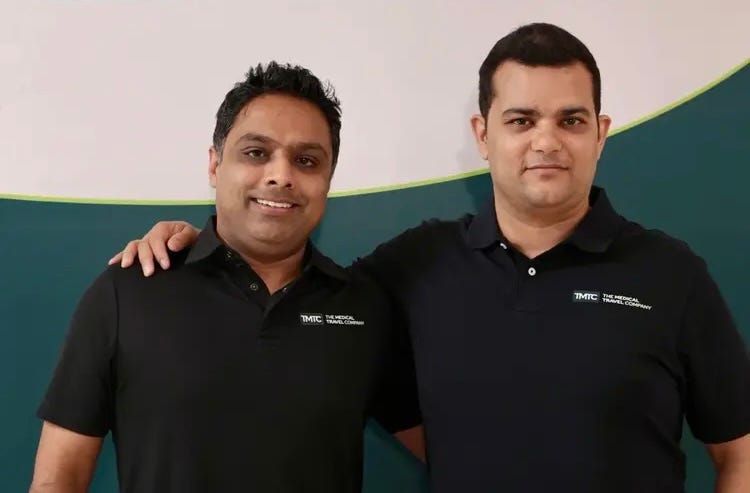
The most interesting deal from October was Nexus Venture Partners’ bet on healthcare tourism company The Medical Travel Company (TMTC). Nexus led a $4.5 million seed round in the UK and India-based startup which facilitates cross-border medical travel by connecting overseas patients abroad with accredited Indian hospitals. The long term plan is to replicate the model in the US, Canada, Australia and Europe.
In vertical plays, L Catterton invested $30 million in proctology-focused healthcare chain Healing Hands Clinic; Bessemer Venture Partners led a $15 million Series A in Pluro Fertility and IVF, which is building a nationwide IVF platform through partnerships with independent fertility specialists; and Verlinvest picked up a 20% stake in eye care chain The Eye Foundation for $75 million.
Finally, AI-related funding continued as the dominant parallel theme during the month. In the next section, we decode what the slew of AI/AI-related investments in October signal.
AI Briefing
AI in India, For India

What’s becoming clear in India’s AI story is that the first real and major traction is coming from the vertical enablers – startups building in India, for India. These companies are layering AI on top of existing workflows to solve grounded, operational problems.
Whether it’s BFSI voice agents (GreyLabs AI) managing millions of customer calls, industrial AI platforms improving factory visibility and uptime (UGX), or credit-intelligence tools (GoodScore) helping lenders automate risk decisions, they’re embedding intelligence where it matters most. GreyLabs AI raised $9.6 million in a Series A round led by Elevation Capital; UGX raised $1 million in a seed round led by Blue Ocean Venture Partners; and GoodScore raised a $13 million Series A led by Peak XV Partners.
This is an AI-enabled business adaptation. A similar pattern appeared in the early 2010s cloud wave, when Indian companies used software to modernize traditional industries.
Today, AI is becoming the next layer of that transformation, turning repetitive, time-consuming and expensive processes into smarter, more efficient systems.
Alongside, a second, albeit smaller, group is quietly emerging: the stack builders. These are companies – UnifyApps, Mem0 and Matters AI – built by Indian founders, with roots in the country, but are selling globally, starting with markets like the US). UnifyApps raised $50 million in a Series B round led by WestBridge Capital; Mem0 raised $24 million led by Basis Set Ventures, with participation from Y Combinator, Peak XV Partners, Kindred Ventures, and the GitHub Fund; and Matters AI raised $6.2 million) in a seed round co-led by Kalaari Capital and Endiya Partners.
They’re not focused on specific sectors, but on the rails that make AI adoption possible such as integration, orchestration, governance, and compliance. They’re laying down the infrastructure that lets enterprises safely deploy AI across systems, without reinventing the wheel each time.
It’s the next logical step in India’s evolution from SaaS exporter to AI infrastructure provider.
Both groups complement each other. The vertical players are racing to prove AI’s ROI in the toughest markets and complex business areas that demand transformation. Meanwhile, the stack builders make that scalability possible worldwide.
Another fun fact: While the first group continues to bring AI into business processes, the true ROI from these systems and whether they are actually delivering value remains elusive. According to McKinsey’s State of AI 2025 survey of nearly 2000 global enterprises, 88% now use AI in some form but only a third have managed scale beyond pilots.
Plus, just 6% reported an EBIT boost above 5% with AI.
Shubham Sharam is a journalist and storyteller who specialises in writing about AI and Data. He has written for leading digital news publications including VentureBeat, Mint, TechCircle and VCCircle. He also co-hosts The Bottom Line podcast where he breaks down technology trends.
Recco | Notes on Culture, Craft, and the Considered Life
The Return of Universal Genève

If you’re considering buying a new luxury watch, pause a moment. One of Swiss watchmaking’s most storied names is set to return next year.
Founded in 1894, Universal Genève made chic, accessibly priced watches with serious mechanical pedigree, its headquarters once wedged between Rolex and Patek Philippe on Geneva’s Rue du Rhône.
The company’s Compax chronographs were especially popular, but it was the Polerouter (1954) that best embodied its old tagline, Le Couturier de la Montre — “the couturier of watches.”
Designed by a young Gérald Genta to mark Scandinavian Airlines’ first polar flight, the Polerouter combined dressy elegance with a pioneering micro-rotor movement.
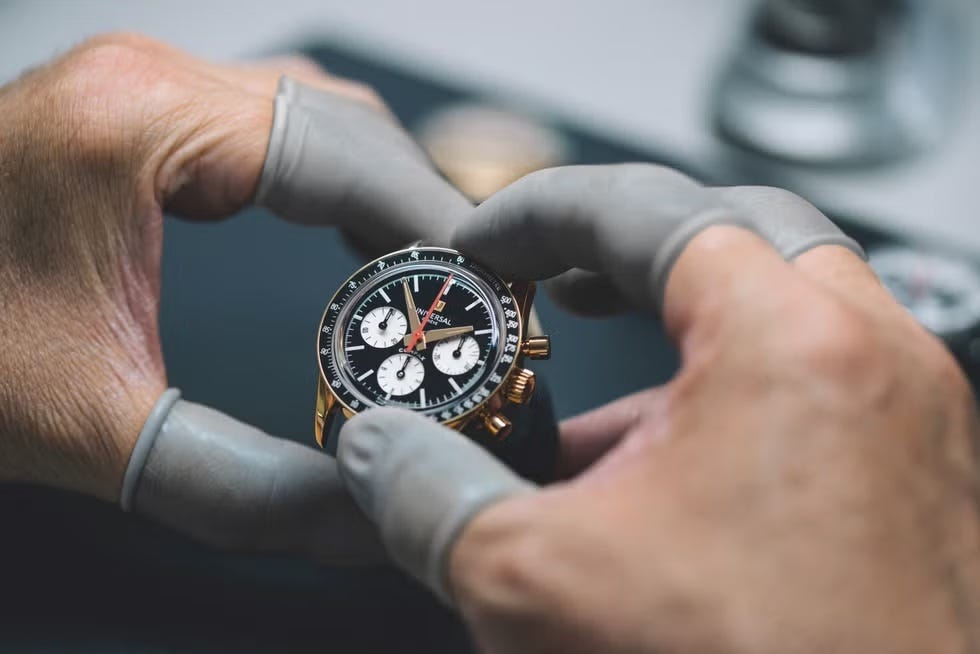
Universal Genève was acquired by Breitling in late 2023 and will operate as an independent maison when it relaunches with in-house movements and dedicated boutiques. The revival began in November 2024, with three Tribute Polerouter models marking the 70th anniversary of SAS’s polar route, faithful reissues that revived Genta’s original design.
Last week, the brand followed with the Tribute to Compax “Nina Rindt” editions, named for the Finnish model and wife of Formula 1 champion Jochen Rindt, who was often photographed at circuits wearing a 1960s Compax on a Bund strap. The new pieces comprise two boxed sets of three chronographs in 18-carat gold, featuring grand feu enamel dials and Bund straps.
These limited editions hint at the direction Universal Genève will take when it finally returns to shelves in 2026. And judging by what’s surfaced so far, the wait will probably be worth it.
Thank you for reading The Runway. We’d love to get your feedback. Drop us a line and stay tuned for the next edition.
Really enjoyed reading this edition, thanks for sharing!
Agree.