



Edition #29. On Thursday, Palo Alto Networks announced its intent to acquire Portkey, an AI infrastructure company based in San Francisco with operations in Bengaluru. The transaction is expected to close in the Nasdaq-listed cybersecurity major’s fourth quarter of 2026.
The acquisition closes the loop on a company that until ten weeks ago was on a venture-funded path to scale. In February, Elevation Capital led a $15 million Series A in Portkey. Lightspeed, which had backed the company’s seed round in 2023, participated in the Series A.
“By the time we led their Series A a few months ago, Portkey was already governing $180M+ in annualized AI spend, processing 500B+ tokens a day… They (founders Rohit Agarwal and Ayush Garg) built cutting-edge infrastructure that the world’s biggest security company wrote a serious check to own,” Krishna Mehra, AI partner at Elevation Capital, wrote in a social media post.
The financial terms of the transaction were not disclosed. The Economic Times, citing sources, reported that the deal carries a cash-and-stock structure at a valuation of $120-140 million.
What’s Portkey?
When an enterprise builds an AI-powered product, it rarely relies on just one model. Portkey sits between the enterprise and these models, the single dashboard, from which the enterprise manages its entire AI operation. This category, the AI gateway, has emerged fairly recently but has become essential infrastructure for any large enterprise running AI at scale.
Founded in 2023 by Agarwal and Garg, Portkey’s clients include Postman, DoorDash, Roche and others across sectors such as finance, pharmaceuticals and technology.
The competitive landscape is still small and includes companies such as LiteLLM, TrueFoundry and Kong. What distinguishes Portkey is that the security and oversight capabilities are built into the gateway itself.
Why Palo Alto Networks bought it
The Portkey acquisition comes shortly after Palo Alto Networks acquired agentic endpoint security firm Koi – a deal that brought on board tools to protect AI systems running on individual devices within enterprises. Portkey adds the next layer.
Increasingly, enterprises are deploying AI agents that act on behalf of employees, often with permission to access sensitive systems and make decisions. Each of these actions involves the agent talking to an AI model, and each conversation is a potential point of failure or attack. Securing that traffic requires an AI gateway.
In its statement announcing the deal, the company said Portkey would become the “central nervous system of Prisma AIRS”, its AI security platform launched last year.
“By integrating Portkey into our Prisma AIRS… we are delivering the industry’s first unified enforcement layer to manage and secure every AI app and agent across the enterprise,” Palo Alto Networks chairman and CEO Nikesh Arora said in a social media post.
Signals for the corridor
For India-US corridor investors, the deal carries long-term value that matters more than the specific economics of this transaction.
AI infrastructure built by Indian-founded teams holds the potential of being acquired by top-tier global buyers as strategic capability, not as an acqui-hire. Portkey is not a small product team being absorbed for its engineering talent. It’s a fairly scaled platform with Fortune 500 customers and the acquisition raises the ceiling on what kind of bets could be taken by investors going forward.
Portkey’s structure – US-incorporated parent, Bengaluru engineering subsidiary, global enterprise go-to-market play — is the same template used by Loop AI, Emergent, Rocketlane, Deccan AI and several others that have raised capital in recent months. Each of these companies operates on the assumption that Indian engineering depth combined with US enterprise distribution is a defensible competitive advantage.
The longer term implications of the deal will become clearer once the financial details of the transaction are known. But, for now, the US-India corridor thesis is certainly on point.
The Week in Deals
Growth Cheques for Home Services, QSRs and Diamonds
A handful of growth stage rounds shaped the week, with $385 million deployed across 18 tracked deals. Lab-grown diamonds, an NBFC, a QSR franchise operator and an on-demand domestic help platform together absorbed a large portion of the capital. Krafton and Naver's Unicorn Growth Fund struck its first deal within a week of its launch.
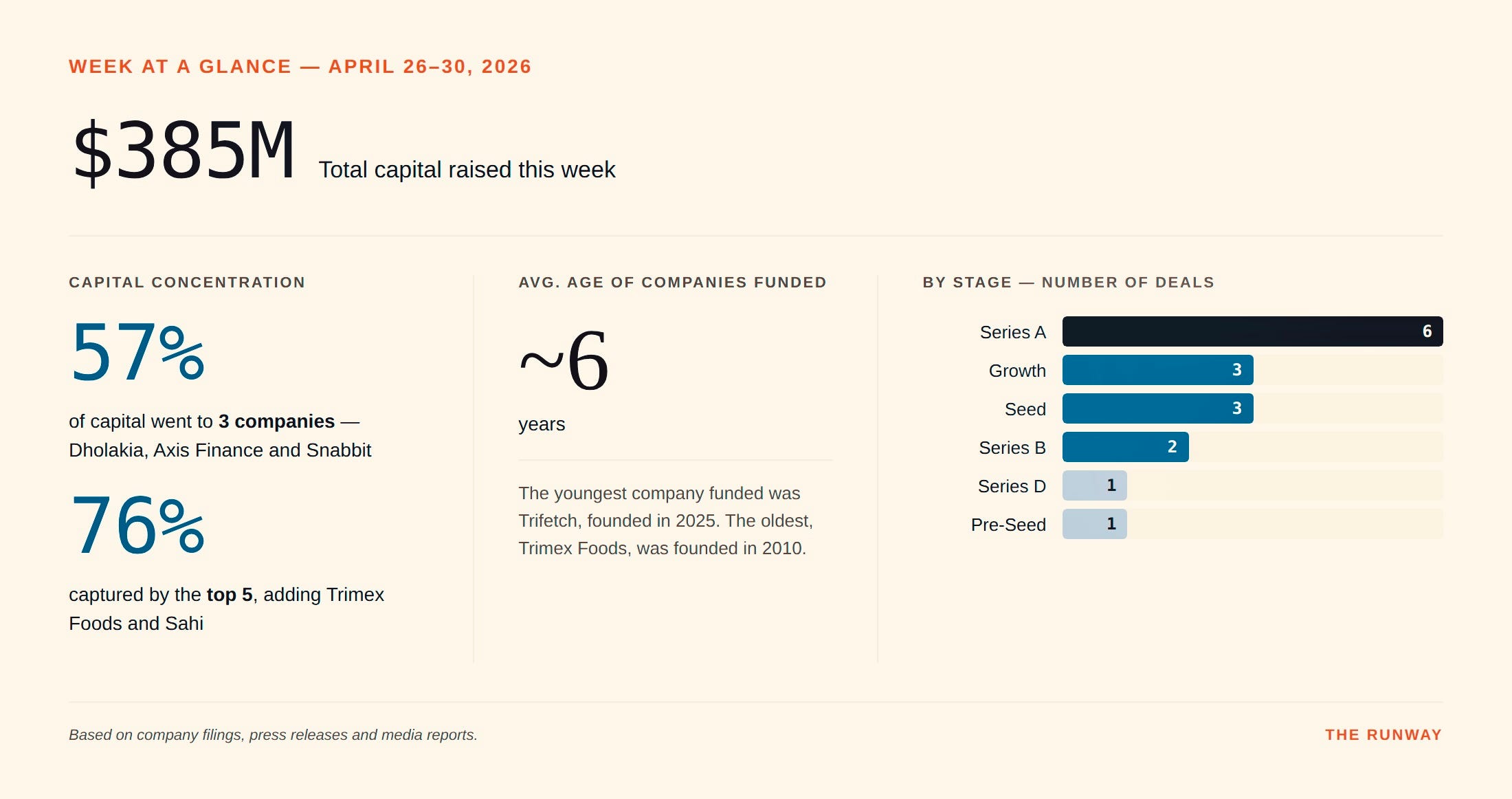
Dholakia Lab Grown Diamond raised over Rs 800 crore ($84.3 million) in a round led by Abakkus PE. ICICI Ventures, investing from IAF5, and Amal Parikh joined the round with other undisclosed investors, the Surat-based lab-grown diamond maker said in a statement.
The space has lately seen a number of startups raise early stage capital. These include Aukera, Limelight, Onya and Lucira Jewellery.
As many as 20 companies raised a combined $186 million as of January this year, according to Tracxn.
Axis Finance raised $79.6 million from Kedaara Capital, which picked up a 5.08% stake. The transaction values the Mumbai-based NBFC arm of Axis Bank at nearly $1.6 billion. Kedaara’s earlier financial services bets include Aavas Financiers (exited its stake to CVC Capital), AU Small Finance Bank and Avanse (co-led a $133 million follow-on round in January).
Snabbit raised $56 million in a Series D round led by Susquehanna Venture Capital, Unicorn Growth Fund and Bertelsmann India Investments. Existing investors Nexus Venture Partners and Lightspeed, and new investor FJ Labs joined the round.
With the latest round, the Mumbai-based on-demand domestic help services platform has raised a total of $112 million and is valued at $360 million-plus post-money.
The deal is Unicorn Growth Fund’s first since its launch just a week ago. The $636 million fund, launched by Krafton and Naver, is managed by Mirae Asset Venture Investments.
Trimex Foods raised $40 million in its first institutional funding round from Siguler Guff. The Delhi-based company is the exclusive Indian franchise partner for global restaurant brands such as Chili’s Grill & Bar, Cinnabon and Paul and operates over 50 restaurants and bakery-cafés across 13 cities in India.
“The platform built over the past fifteen years is notable, representing a scalable, multi-brand platform with industry-leading execution and a strong customer following,” Siguler Guff partner and co-portfolio manager Shaun Khubchandani said in a statement.
New York-based Siguler Guff is currently raising the $300 million Global Emerging Markets Growth Opportunities Fund II, which has a large India mandate. The firm’s prior investments here include La Renon, Rajasthan Royals, and VerSe Innovation.
Sahi raised $33 million in a Series B round led by existing investor Accel. Elevation Capital, also an existing investor, joined the round. The Bengaluru-based stock trading platform uses AI to provide real-time market intelligence for trading, apart from other tools.
Kimbal raised $22 million in a Series B round led by GEF Capital Partners. Existing investor Niveshaay, investing from the Sambhav Fund, participated in the round. The Delhi-based company develops advanced metering infrastructure, RF mesh communication networks, AI-based meter reading and other energy management tools.
Metasports Interactive, maker of multi-player cricket game Hitwicket, raised $20 million in user acquisition (UA) financing from London-based company Metica. Unlike conventional equity funding, UA financing is typically non-dilutive and earmarked specifically for marketing and player acquisition. For Hyderabad-based Metasports, the structure helps accelerate growth without founder equity dilution.
Credilio Financial Technologies raised $10.5 million in a Series A round for Novio, an app that primarily offers UPI-powered, fixed deposit-linked credit cards. The round in the Mumbai-based company was led by existing investor Cornerstone Ventures. Shepherd’s Hill Private Equity, ESV-Arthya AIF and Roots Ventures participated in the round, which included venture debt from Innoven Capital and Alteria Capital.
HyugaLife raised a $10.5 million Series A round led by IvyCap Ventures. First Bridge participated in the round. The Mumbai-based company operates an ecommerce platform for health and nutrition products. The startup had earlier raised capital from Peak XV Partners’ Surge programme.
OpenObserve raised a $10 million Series A round led by Nexus Venture Partners and Dell Technologies Capital. Both are existing investors who participated in the company’s seed round. The San Francisco-based company offers an AI-native, open-source observability platform that helps businesses monitor, troubleshoot, and analyze apps and systems in one place.
Other deals this week:
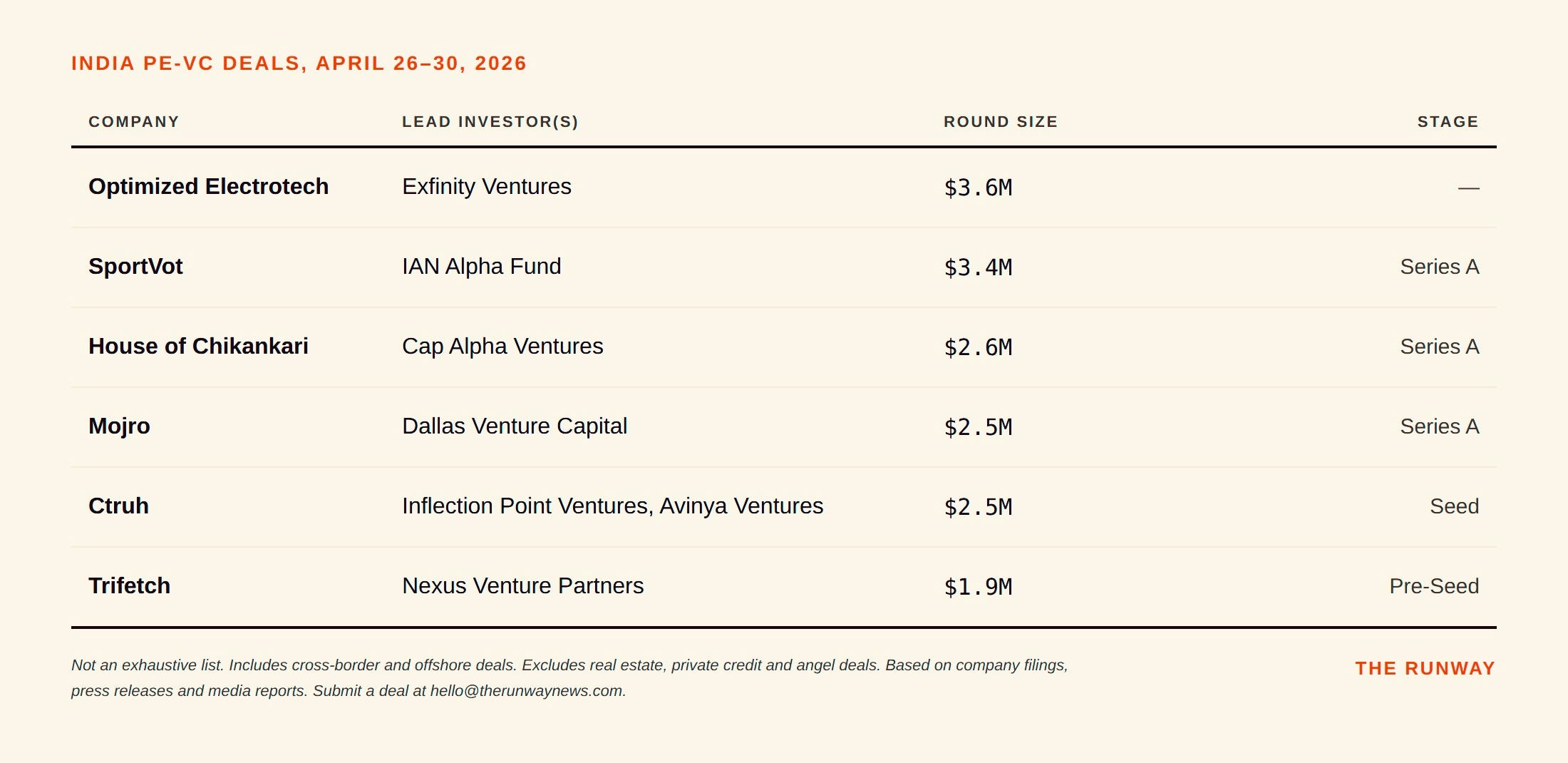
Sub $1 million deals: Climate-tech company Prithu raised $1 million in a seed round led by Transition VC. AIoT startup Ubiqedge raised $1 million in a seed round led by Piper Serica.
Submit a deal for The Runway Briefing by replying to this email or write to us at hello@therunwaynews.com.
Recco | Notes on Culture, Craft and the Considered Life
The Honolulu J6FC+: A Sensible All-Court Paddle
As we are all aware, pickleball has properly taken off, and along with it, the paddle market has gone a bit mad. Every week there’s a new “power” paddle, a new “control” paddle, and a new material that’s meant to change your game overnight.
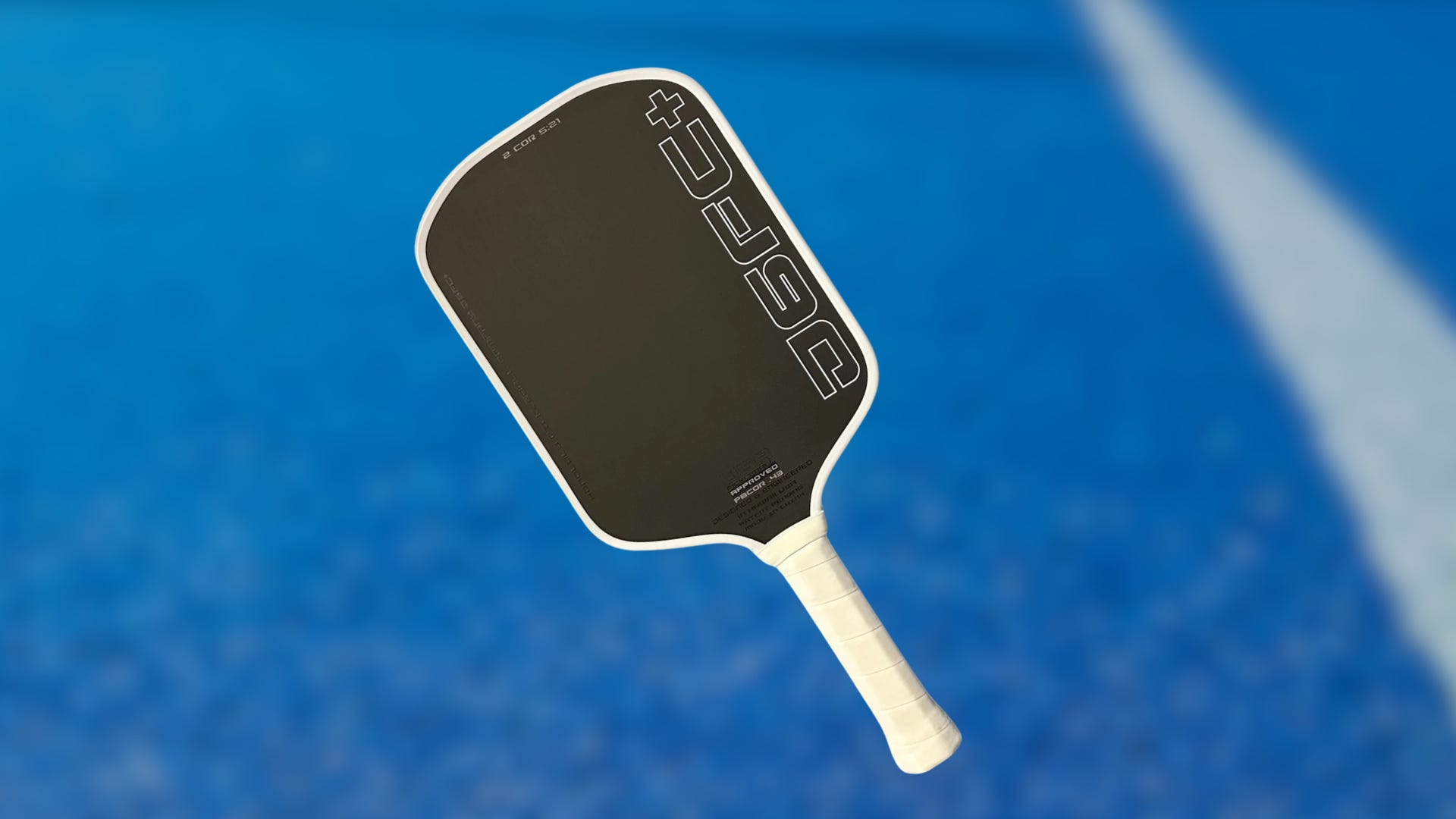
If you’re playing for fun—and you don’t want to spend nights reading paddle reviews—you really just need one thing: something solid, predictable, and easy to live with. The Honolulu J6FC+ looks like it fits that brief.
It’s built around a full carbon-fibre face, with a 16mm core, and it sits in a comfortable middle zone on weight, about 230 grams. It’s also an elongated paddle, which should give you a bit more reach, and the handle is long enough for a two-handed backhand if you use one.
None of this is magic, but it’s a sensible set of choices for most casual-to-regular players: stable in the hand, not tiring, and not overly specialised. Most importantly, you’ll stop thinking about it after five minutes. If you’re travelling, it’s an easy buy — otherwise, ask someone to bring it back.
Recco is a column by Murali Menon. Murali has spent a career paying close attention to how things are made, where they come from, and why some of them endure. Every edition, one recommendation: a maker, an object, a place, a practice.
Thank you for reading The Runway. We’d love to get your feedback. Drop us a line at hello@therunwaynews.com or just reply to this email.