


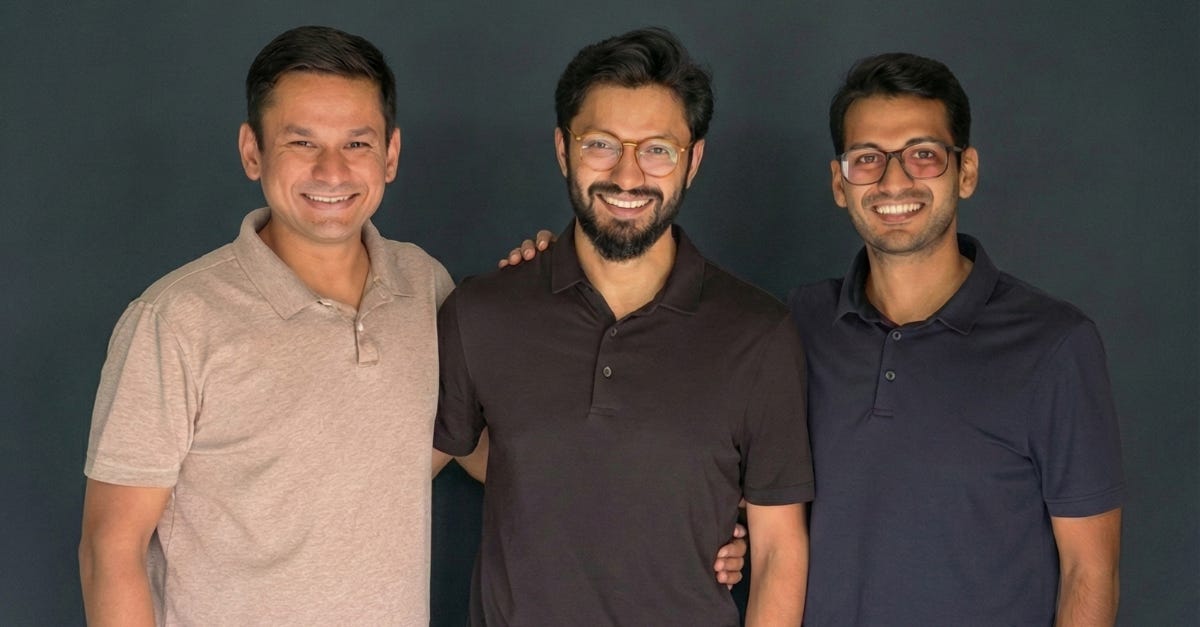
Edition #16. The revolving door at Sequoia Capital’s former India outpost, now known as Peak XV Partners, has never really stopped spinning. This week, three managing directors – Ashish Agrawal, Ishaan Mittal and Tejeshwi Sharma – announced their departures and plans to launch an independent venture capital firm. The trio joins a remarkably long list of senior fund managers who have walked away from the country’s largest and arguably most influential venture capital firm.
The latest departures follow disagreements, related primarily to compensation, between the firm’s top leadership and Agrawal.
“We have mutually decided to part ways with Ashish Agrawal. After thoughtful consideration and discussions, it became clear that parting ways was in the best interests of our Limited Partners and the long-term interests of the firm,” the firm said in a post on LinkedIn.
On the nature of the disagreement, Peak XV managing director told The Economic Times that while the firm’s “economic system is fair and generous… There were disagreements on this topic.’” He also told the publication that the departures of Mittal and Sharma were unexpected.
Senior fund managers leaving en masse has been a recurring pattern at Peak XV – even prior to its separation from Sequoia Capital.
A history of disagreements
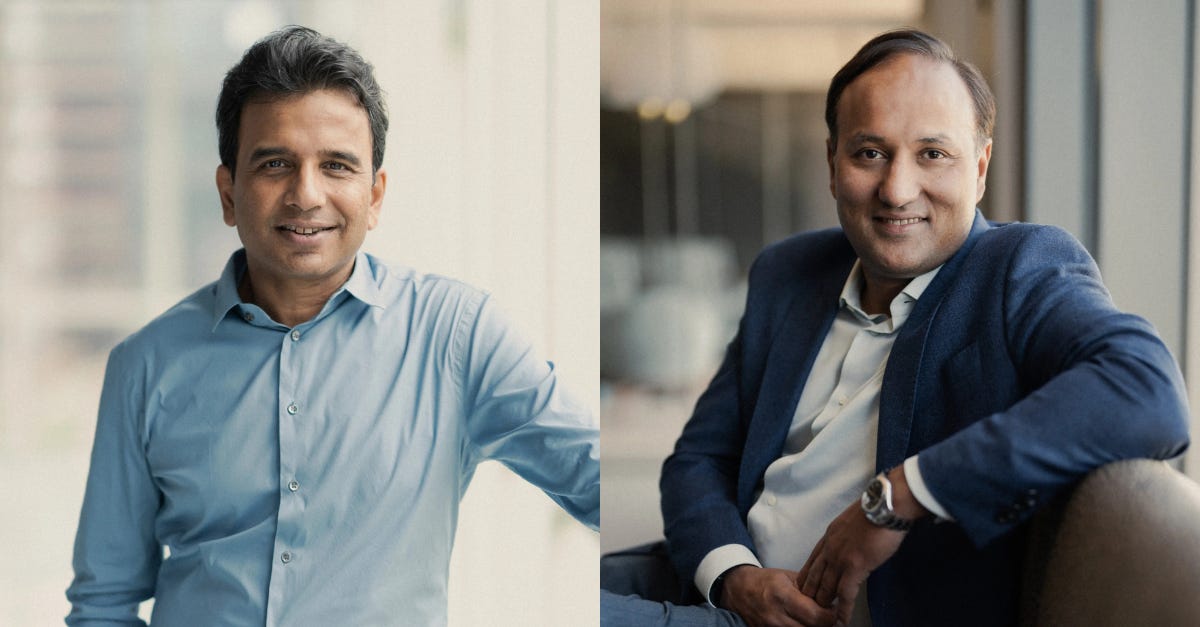
The pattern can be traced right back to its inception.
Sequoia Capital set up a local presence in India in 2006 through a partnership with homegrown venture capital firm WestBridge Capital Partners. The move positioned Sequoia ahead of competitors in what would become one of the world’s fastest growing startup ecosystems. WestBridge rebranded itself as Sequoia Capital India and its founding partners – Sumir Chadha, KP Balaraj, Sandeep Singhal and SK Jain – became the face of the Menlo Park based firm’s operations here.
By 2011, the partnership had unravelled.
Chadha and his partners believed that investing in India called for an approach different from Silicon Valley. In 2011, India’s technology startup ecosystem was still nascent and applying the Silicon Valley brand of early stage investing was tough, even unrealistic. The universe of listed companies, on the other hand, offered private capital investors opportunities to get in fairly early and build value towards attractive, non-linear returns.
“We’ve been doing a bit of this (public investing) within Sequoia and we feel the next wave of opportunity is in that space,” Chadha told me at the time in an interview for Businessworld.
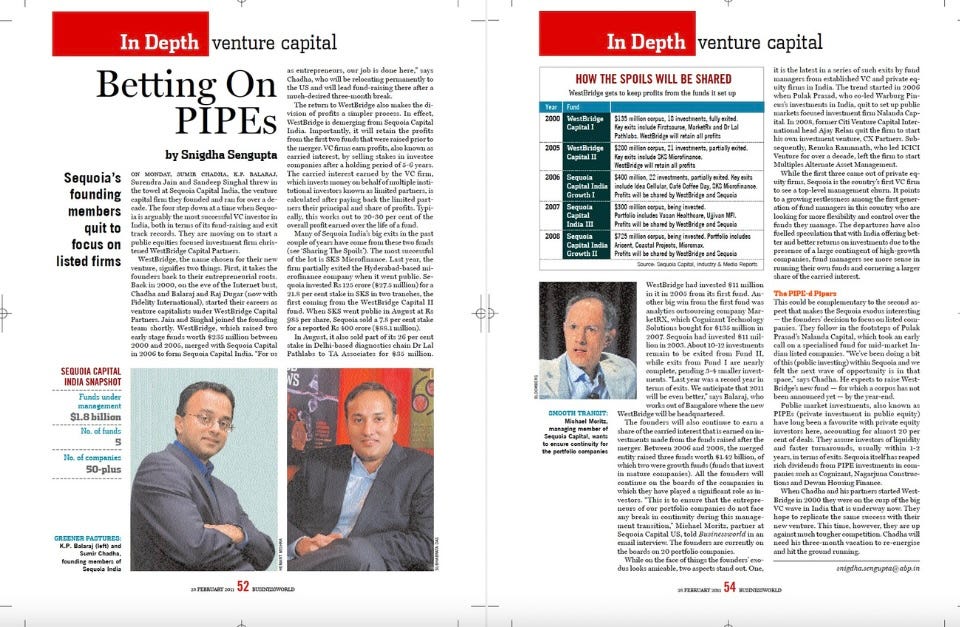
They separated from Sequoia – after having grown the India outpost to nearly $1.8 billion in assets under management (AUM) – and resurrected WestBridge Capital with a stated mandate to invest in publicly listed companies. WestBridge now commands an AUM of over $7 billion and backs both public and private companies.
Their departures cleared the decks for the next generation of fund managers to step in. Abhay Pandey, GV Ravishankar, Mohit Bhatnagar, Shailendra Singh and VT Bharadwaj took over the reins of the firm. At the time of the separation from the WestBridge team, Sequoia’s Mike Moritz told Businessworld (in an email), “I am confident that it will be business as usual.”
It was. For a bit.
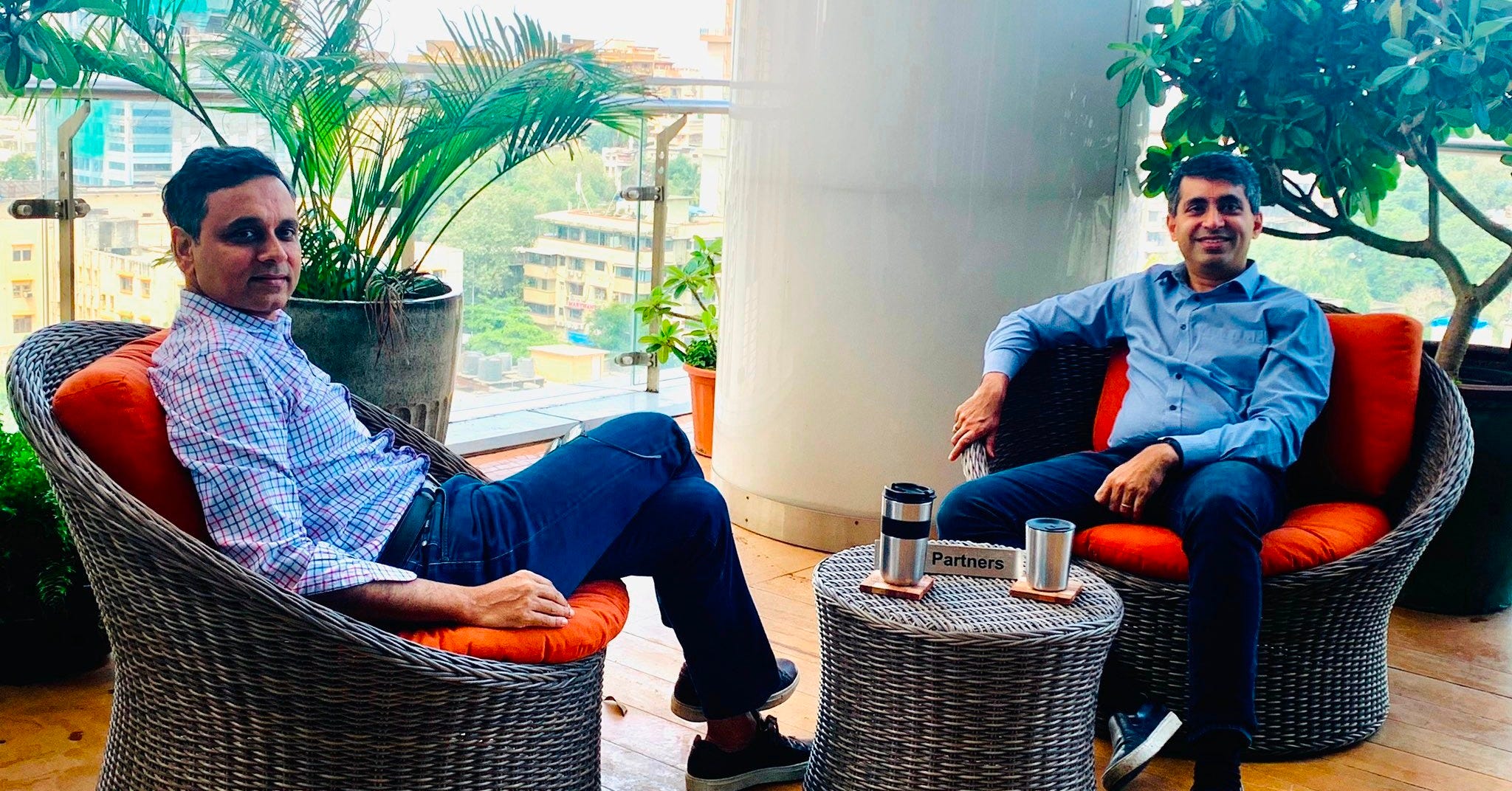
For six years, there were minimal changes to the partnership and Sequoia’s AUM swelled to nearly $4 billion. Then, in 2018, Abhay Pandey, who led consumer and healthcare investments, announced his departure on the same day that Sequoia India raised its smaller than targeted sixth fund. The trigger was a disagreement over the firm’s future strategy for India.
Pandey, Sequoia India said in a statement at the time, wanted to create a dedicated consumer fund. “Sequoia is committed to consumer investments; dedicated sector funds, however, are not part of Sequoia’s structure,” it said.
Incidentally, Pandey’s departure was preceded by managing directors Gautam Mago and VT Bharadwaj exiting the firm. The three teamed up to start A91 Partners, a venture growth investment firm that now manages an AUM of over $1.5 billion with a mandate to invest across consumer, financial services and healthcare. Today, the A91 Partners portfolio includes some of the countries most sought-after consumer businesses including Atomberg, Blue Tokai Coffee and Sugar Cosmetics.
The post-independence exodus
The team and partnership upheavals up until 2018 though seem mild compared to what’s been underway over the last couple of years.
The big global ‘reorganisation’ in 2023 that separated Sequoia India from its parent and led to the creation of Peak XV — it inherited an AUM of about $9 billion spread across a dozen-odd funds — was widely speculated to have been triggered by multiple factors. Those included the US parent’s dissatisfaction with overall portfolio performance and growing disagreements over profit sharing.
Since going independent, the firm has haemorrhaged talent at an unprecedented pace.
Including the latest departures, more than a dozen senior professionals across investing and operating roles have left after extended tenures. Some of those are:
Managing directors Piyush Gupta (2024), Shailesh Lakhani (2025), Abheek Anand (2025) and Hashjit Sethi (2025)
Surge partner Anandamoy Roychowdhary (2024)
Public policy lead Shweta Rajpal Kohli
Agrawal, Mittal and Sharma are leaving at an inconvenient juncture.
Peak XV is reported to be nearly at the finish line for raising commitments for its next fund – the first after its separation from Sequoia. The targeted $1.2-1.4 billion fund comes amidst intense scrutiny from limited partners. In late 2024, the firm had to cut the size of its $2.8 billion growth fund (raised in 2022) by 16%. It also had to lower management fees on multiple existing funds to 2% and reduce its share of profits (carried interest) to 20%.
Natural attrition or a deeper malaise?
It may be argued that ultimately institutions are bigger than people. And, despite the exodus of talent since it separated from Sequoia, Peak XV is coming off a strong year in terms of performance. In 2025, five of its portfolio companies – Groww, Pine Labs, Capillary Technology, Wakefit and Meesho – listed on the public markets and the firm is sitting on significant unrealised gains. Several more are slated to go public this year.
So why should the revolving door be a matter of concern?
With each departure and more so when it’s an exodus, institutional knowledge walks out the door. The partners who have left have scripted or played integral roles in some of Peak XV’s biggest successes – Ashish Agrawal and Groww; Shailesh Lakhani and Minimalist, Truecaller among others.
Fund managers leaving established firms to strike out on their own is de rigueur in the venture capital business across the world. But at Peak XV, the pattern suggests deeper organizational challenges beyond normal attrition. Whether these stem from compensation structures, partnership dynamics, strategic disagreements, or cultural factors, they’ve remained unresolved for nearly two decades.
Each spin-out creates a formidable competitor. WestBridge now competes directly with Peak XV for later stage deals and has nearly closed the gap in AUM terms. A91 Partners targets similar growth stage opportunities. Plus, these firms are intimately familiar with Peak XV’s playbook.
For limited partners, the pattern should raise red flags. A firm that loses key partners ever so frequently, especially on account of internal conflict, carries succession risk (10-year fund cycles demand continuity) and introduces instability and loss of confidence within the portfolio.
At a time when India’s venture capital market is hard pressed to demonstrate returns and sustainable growth after a decade of sometimes unbridled investing, a revolving door is not a problem Peak XV’s top deck or its limited partner want to have to contend with.
Thank you for reading The Runway. We’d love to get your feedback. Drop us a line.
Hi Snighda! I think this is partly because of the rise of Micro VC funds that have a specific focus in terms of sector. Specialists in firms are leaving to launch their own sector-specific fund vehicles as it is more lucrative. I have been following the exodus in PeakXV. The exodus is not only because of broader macro trends but because of internal conflicts on investment strategy.
A good read