


The first two quarters of 2026 are done and it mostly looks somber. There’s a lot less money going around and that’s likely to continue into the next six months. It’s not all bad though. Consumer and enterprise tech continue to be investor favourites. In Edition #38 we take a quick look at how private capital behaved from Q1 to Q2 — a preliminary assessment ahead of our upcoming quarterly reading of the market.
New to the The Runway? Subscribe for a comprehensive view of the deals, strategies and people shaping private equity and venture capital in India every week. Find us on LinkedIn and WhatsApp if you want to keep track of updates on future editions.
Lead
Enterprise Tech, Financial Services, Consumer Lead a Slower Q2

Packaged snacks, dairy products and instant home services competed with data centres, AI and home finance for attention in a slower market for private equity and venture capital (PE-VC) investments in India during the first six months of 2026.
While nearly $13 billion was deployed across 431 deals between January and June, investments dropped 32% in the second quarter and capital concentrated around fewer businesses. The sharpest decline was in April when investments plunged to $1.65 billion from $4.11 billion a month ago. The decline continued into May, falling well below $1 billion.
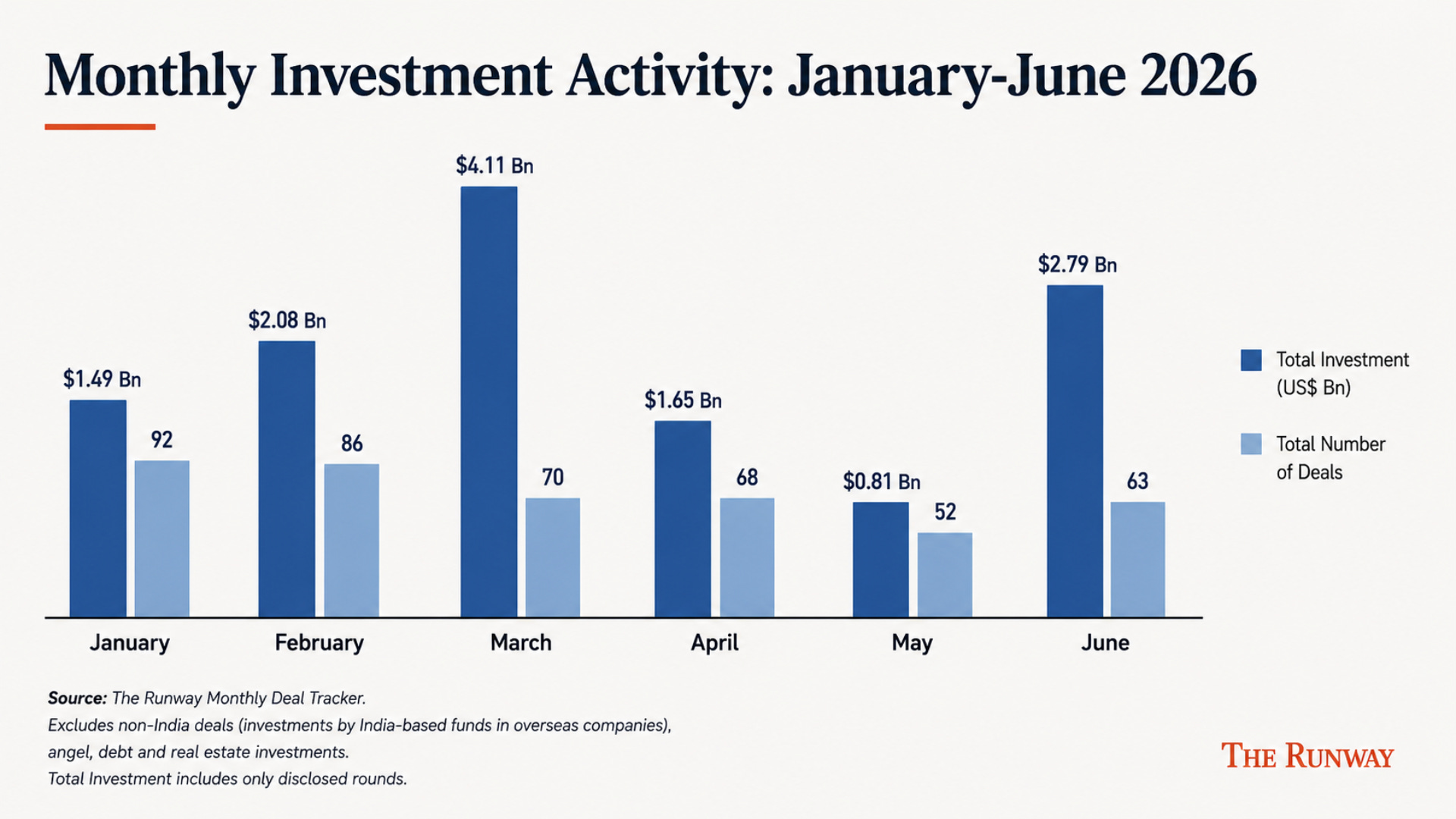
The headline numbers aren’t encouraging.
But there were some winners.
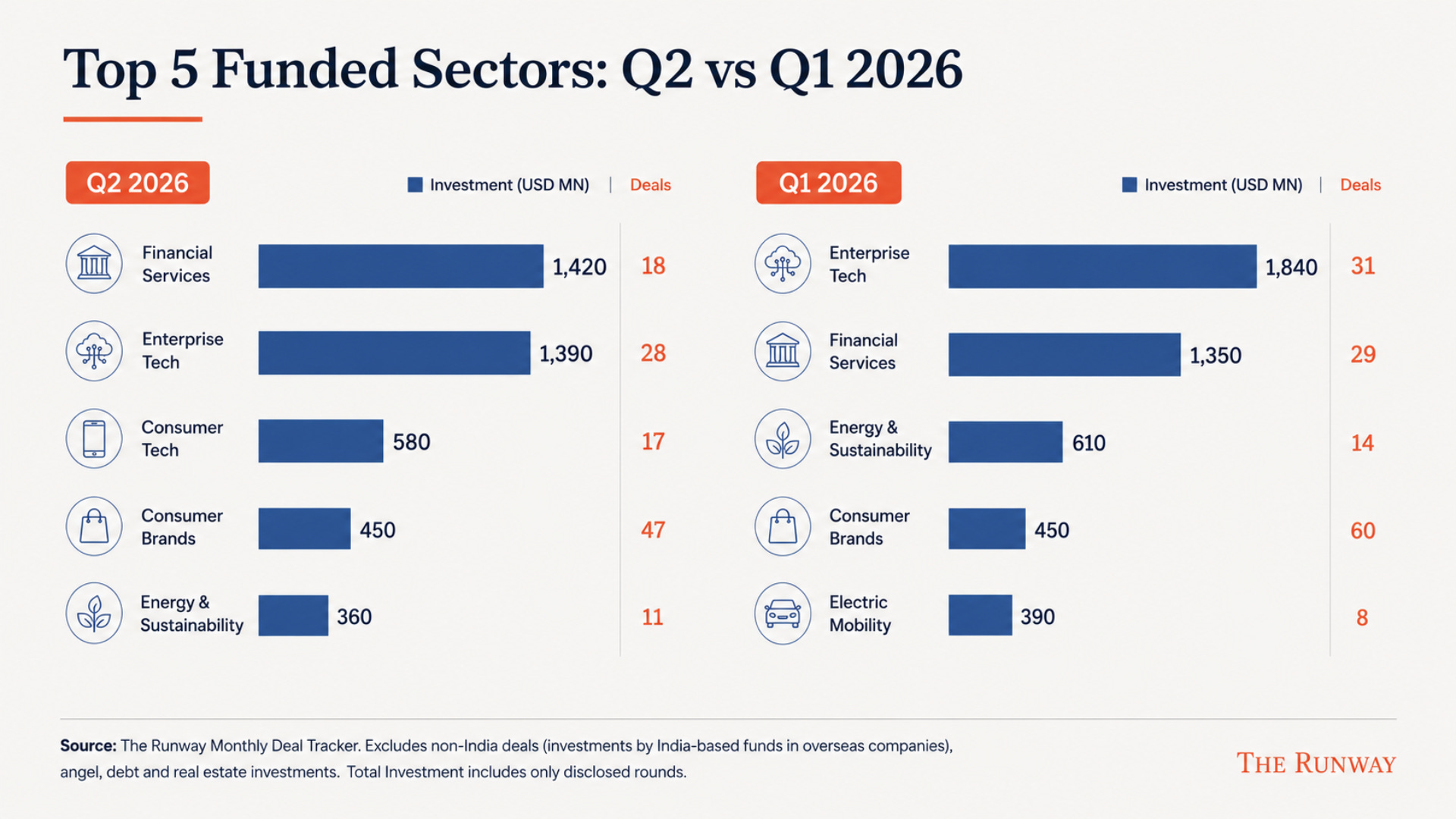
India’s consumption economy was the busiest in terms of the number of deals struck, cornering 33% of the 431 deals in the first six months.
Capital flows into homegrown consumer businesses (consumer brands and consumer-tech) increased from $760 million in Q1 to $1.03 billion in Q2.
From packaged food and personal care to ride hailing apps and quick commerce, investors spread their bets across the spectrum.
Consumer businesses, however, accounted for only 14% of the total capital deployed during the first six months. Financial services and enterprise technology were investor favourites in terms of attracting capital at scale – $2.7 billion and $3.2 billion respectively. The concentration of capital was also high in these two sectors – 47 deals in financial services and 59 in enterprise technology.
Specific to enterprise technology, the largest deals involved data centre companies riding on the AI infrastructure momentum – Nxtra Data ($1 billion), CtrlS ($741 million) and Neysa ($600 million).
The slower investment environment in India is in line with a downturn in PE-VC markets around the world. Global deal value declined 22.8% quarter-on-quarter to $419.8 billion in Q2 2026, primarily due to disruptions caused by geopolitics and AI, according to PitchBook. Liquidity was a concern as exits dropped 19.7% to $275 billion, which in turn impact fundraising by PE-VC firms.
Exits are a concern in India as well with the public markets less receptive this year to initial public offerings (IPOs) by PE-VC-backed companies. More than a few such companies listed at significant discounts to their offer prices and several others have delayed their IPOs to muster better valuations. In parallel, exits via secondary deals have become more frequent with fund managers under pressure to deliver returns to limited partners from ageing portfolios.
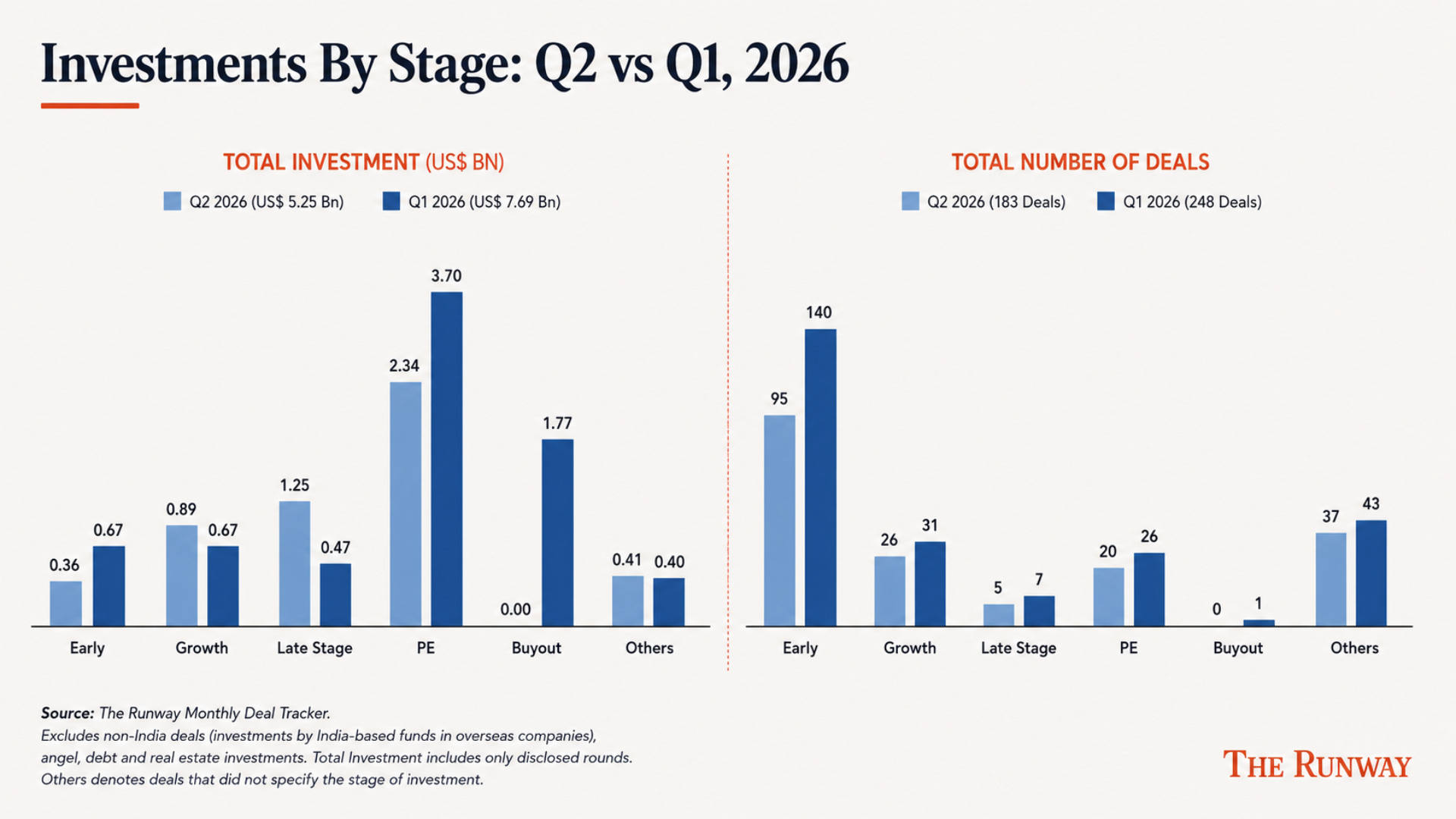
Despite weaker market conditions, early stage investing remained resilient in the second quarter. While the early stage (pre-seed to Series A) deal count in Q2 dropped to 95 from 140 in Q1, it was still the most active category in the first six months.
Going into the second half of the year, investments are expected to remain under pressure as investors recalibrate their deployment strategies around external and internal disruptions.
We’re already witnessing one defining pattern as an outcome of the disruption caused by AI. An increasing number of homegrown investors are striking deals overseas. May (11 deals) and June (14 deals) were exceptionally busy months for investments in largely AI-related companies based primarily in the US.
We’ll share a more detailed analysis of Q2 2026 in the next edition Signals, our quarterly reading of India’s PE-VC market, soon. Stay tuned.
The Week in Deals
Adar Poonawalla’s Renewables Bet; Leg Up for Elder Care

A quieter week for funding activity in India’s PE-VC market, with just $185 million invested across 18-odd deals. Last week, of course, was an outlier because of Cred’s mega raise. The surprise deal this week was Ninjacart, which came out of the woodwork to raise a $6 million bridge round from existing investors.
Inox Clean Energy raised Rs 700 crore ($73.4 million) in a new funding round from Rising Sun Holdings, an investment vehicle for Serum Institute promoter Adar Poonawalla’s family office.
The round values the Noida-based company at Rs 70,000 crore (approximately $7.3 billion), it said in a statement.
In January, the company, part of the INOXGFL Group, raised Rs 3,100 crore (approximately $343 million) from an investor group led by the California Public Employees’ Retirement System (CalPERS), a long-time investor in India’s PE market.
Inox Clean Energy manufactures solar modules and cells which are used to establish captive hybrid renewable power generation capacities.
The Indus Valley raised $17 million in a Series B round led by Gaja Capital. Existing investors DSG Consumer Partners and Rukam Capital joined the round. The Bangalore-based company manufactures and retails toxin-free cookware.
Incuspaze raised $15.8 million in a new funding round from Bharat Value Fund. The round comes shortly after the Gurugram-based co-working and office solutions provider acquired Hyderabad-based peer iKeva to grow its presence in the country’s southern markets.
BatX Energies raised $11 million in a Series A round led by IvyCap Ventures. Co-investors in the round included Zephyr Peacock, and the family offices of the promoters of Mankind Pharma and Excel Industries Family Office. The Gurugram-based company recovers and recycles minerals such as lithium, cobalt and nickel from end-of-life batteries.
PlayBlue raised $11 million in a seed round led by Centre Court Capital and MIXI Global. WEH Ventures joined as a co-investor. The Ahmedabad-based company is building an omnichannel retail platform for sport and sport-related products.
Dovetail Capital, a Mumbai-based firm that helps global and domestic asset managers set up and operate investment funds in India, raised $10.4 million in a Series A round from Elev8 Venture Partners.
Kapture CX raised $10 million in a pre-Series B round led by Bajaj Finserv Ventures. Existing investors Cactus Venture Partners and India Alternatives joined the round. The Bangalore-based company offers a SaaS customer experience automation platform for enterprises.
Phitku, a Gurugram-based company that retails alum-based skincare products, raised an undisclosed amount from Ananta Capital. The investment firm, backed by the Taparia Group (Famy Care) picked up a majority stake in the company. Multiple media outlets put the deal size at Rs 100 crore ($10.4 million).
Age Care Labs raised about $9 million as part of the first tranche of an ongoing Series B round. Rainmatter, Pegasus Finvest and Shrem Group invested in the current tranche. The Gurugram-based company caters to the elder care market through two platforms – Epoch Elder Care and Emoha, which provides assisted living and residential care homes, and Emoha, a membership-based platform that delivers health monitoring, emergency response and concierge services. The Age Care Labs platform was launched and anchored by Lumis Partners. Epoch Elder Care was acquired by the platform in 2021.
Ninjacart raised $6 million in a bridge round from existing investors Accel, Tiger Global and Infosys co-founder Nandan Nilekani. The round is the first tranche of a larger infusion and comes over four years after it last raised capital. The Bangalore-based company claimed that it had turned EBITDA-profitable.
Supply6 raised $5 million in a new funding round led by Unilever Ventures. Existing investor Zeropearl VC participated. The Bangalore-based company retails nutritional products and supplements.
Sub-$5 million deals: Consumer brands venture studio BCT Ventures raised $4.4 million in a seed round from 3one4 Capital. Banking infrastructure company Spense raised $2.8 million in a seed round led by Arkam Ventures. Industrial process air conditioners maker Albatross Energetics raised $1 million from Transition VC. AI-led test-prep startup Lytmus AI raised $0.5 million from Boundless Ventures. Lifestyle brand Cunin raised $0.4 million from All In Capital and Huddle Ventures.
In overseas funding deals, Venture Catalysts led a $0.5 million round in Singapore-based AI startup Clairva.
Submit a deal for The Runway Briefing by replying to this email or write to us at hello@therunwaynews.com.
Recco | Notes on Culture, Craft and the Considered Life
The Shirtmaker Chanel Wanted


Chanel’s acquisition of Charvet earlier this week is as good a time as any to spotlight this venerable, nearly 190-year-old brand that still does things the old way.
Charvet is not just among the world’s finest luxury shirtmakers; it was the world’s first specialist shirtmaker. Its home remains the same townhouse in Paris, where generations of statesmen, industrialists, royalty and exceptionally well-dressed men have commissioned shirts.
Marcel Proust was a patron, and so were John F. Kennedy, Yves Saint Laurent and Coco Chanel, who was introduced to the shirtmaker by her lover — and British polo player — Arthur Capel.
Charvet is famous for its impossibly soft cottons, Sea Island fabrics, hand-finished details and an astonishing library of colours and patterns. Some of its ready-to-wear shirts, slippers and accessories can be purchased online. But if you’re looking to go bespoke, you’ll have to visit 28 Place Vendôme, where you can choose from more than 6,000 fabrics. A ready-to-wear shirt starts at around €500. Bespoke costs considerably more.
Chanel didn’t acquire Charvet because it needed to make better shirts. It acquired Charvet because heritage, when it’s genuine, is almost impossible to recreate.
Also read: 100 Hands Comes Home
Recco is a column by Murali K Menon. Murali has spent a career paying close attention to how things are made, where they come from, and why some of them endure. Every edition, one recommendation: a maker, an object, a place, a practice.
Thank you for reading The Runway. We’d love to get your feedback. Drop us a line at hello@therunwaynews.com or just reply to this email.