


A delayed monsoon, record heat, and water shortages. India is parched. But the dollars continue flowing in to underwrite the country’s bid to become a global data centre hub. The latest to throw its hat into the ring is Canada’s largest pension fund manager. Also, India has a new AI unicorn — a worthy milestone but with plenty of caveats. Welcome to Edition #36.
New to the The Runway? Subscribe for a comprehensive view of the deals, strategies and people shaping private equity and venture capital in India every week. Find us on LinkedIn and WhatsApp if you want to keep track of updates on future editions.
HCLTech Vaults Sarvam AI Into The Unicorn Club

Sarvam AI is now valued at $1.5 billion following the first close of a targeted $300 million Series B round. The Bangalore-based company raised $234 million, of which $150 million is being invested by HCLTech for a 10.46% stake. Bessemer Venture Partners joined the round as a new investor. Khosla Ventures and Peak XV Partners were returning investors.
The Series B came just three days after Anthropic disabled access for all non-US users to Claude’s most advanced models, Fable 5 and Mythos 5, acting on an order from the US government. Sarvam last raised capital over two years ago when Lightspeed Venture Partners led a $41 million Series A.
What’s HCLTech buying?
HCLTech generated $14.7 billion revenues in FY2026, the bulk of it from clients in the US and Europe. It already has what those clients need – a partnership with OpenAI, signed in June last year to deliver enterprise AI services. Infosys and TCS have equivalent deals with Anthropic. These are access arrangements whereby the information technology (IT) services firm gets to use a model it doesn’t own. The Sarvam investment gives HCLTech ownership and access.
What that ownership buys, specifically:
A foothold in India’s enterprise AI market. Sarvam’s models are built for India-specific languages, data and regulated sectors. Its clients – SBI Life, LIC, IDFC, Tata Capital and CRED – are in banking and insurance where regulations on data residency make foreign-hosted models difficult to use regardless of their capability. HCLTech’s India business, though a much smaller part of its overall revenues, grew 5.7% in FY2026, faster than its US revenues at 2.3%.
An opening in sovereignty-driven markets. HCLTech’s regulatory filing states that the investment will help the company build “sovereign AI solutions for governments, regulated industries and enterprises seeking localized, secure and compliant AI deployments.” Apart from the US and Europe, the Noida-based company has a presence in the Middle East, Southeast Asia and part of Africa.
A hedge against limited access to foreign models: HCLTech’s annualised revenues for what it called its Advanced AI services crossed $620 million in the fourth quarter of FY2026 – revenue built on top of models it doesn’t own. If access to frontier models gets restricted further, HCTTech would need alternatives. Sarvam is one candidate. AI services are estimated to open up a $300-400 billion market for Indian IT services companies by 2030 despite a 2-3% projected annual revenue deflation in the near-term. Having options to address that market is good business.
What Sarvam brings to the table (or not)
Within its domain, Sarvam, according to its own disclosures, has built a few things:
The 105B and 30B models have been trained from scratch in India.
Its document processing tools have digitised over 35 million pages.
Its conversational platform handles 2 million interactions a day.
The voice platform has collected crop data from 17 million farmers for the Ministry of Agriculture and supported renewals for 45 million insurance policyholders.
But the numbers also show that the company is still at a very early stage. Sarvam’s unaudited FY2026 revenues were at Rs 45 crore (according to HCLTech’s regulatory filing), up from Rs 1.5 crore in FY2025. In terms of technical capability, the company claims that its flagship 105B model “matches or outperforms larger reasoning models on knowledge, reasoning and agentic benchmarks.”
“Sarvam’s moat is strong. Indian languages, Indian data, the regulated sectors that actually need it. But, in the agentic era, it’s well behind the giants winning enterprise right now,” technology journalist Shubham Sharma* tells us. He points to a specific gap. Sarvam’s 105B model scores 12 on the Artificial Analysis Intelligence Index, while Google’s Gemma 4 31B, under a third the size, scores 29.
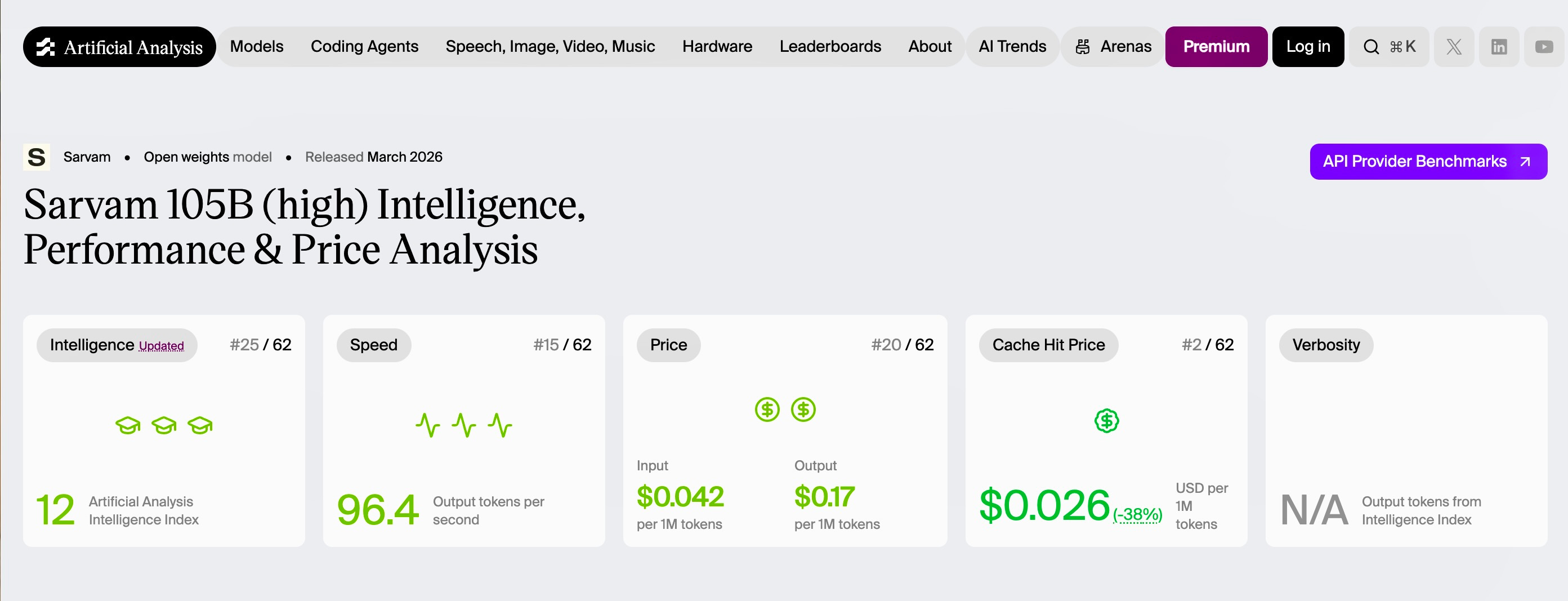
“The market’s energy has broadly moved to two ends. Small, performant models that run on your device, and frontier or near-frontier models running agents that do that work – building apps, raising invoices, sending pitches. Not just answering questions. Sarvam’s flagship (105B) sits in between – neither cheap enough to run locally, nor capable enough to run advanced agentic capabilities. Two years ago this would have been a strong product. Now it feels like one that’s lagging behind.”
To win, Sharma adds, Sarvam will need to hold on to its moat and build towards what buyers actually need – a model that works with accuracy, speed and efficiency across all workflows, whether Indian-associated or just something as simple as logging data in an Excel sheet.
The same week Sarvam closed its round, China’s DeepSeek raised $7.4 billion at a valuation exceeding $50 billion, according to a Reuters report on June 16, citing The Information. Reuters said it had not independently verified the report. DeepSeek’s flagship V4 Pro – at roughly 1.6 trillion parameters against Sarvam’s 106 billion – scores 44 on the Artificial Analysis Intelligence Index. The two models aren’t a clean match: different scale, different cost and different design intent. DeepSeek’s V4 Pro aims at the general frontier while Sarvam’s 105B is for Indian languages and regulated sectors. The gap though is still informative as a measure of the distance between where each country’s best funded AI effort stands.
What to watch
Sarvam is backed by some of India’s most active venture capital investors. The same funds, along with corporate strategics, are also deploying significant capital overseas. Take Peak XV Partners, a returning investor in Sarvam’s Series B. The Bangalore-based venture capital firm has struck 27-odd deals this year and nearly half involve companies based in the US or in other overseas markets, The Runway reported earlier this month.
On June 12, the day Anthropic disabled Fable and Mythos, Bangalore-based IT services major Wipro joined Arcade.dev’s $60 million Series A, a San Francisco-based company building a security and authorization layer for enterprise AI agents.
What emerges is that India’s most capable venture capital firms and IT services majors are not converging on a single sovereign AI strategy; they are making different, sometimes opposite, bets at the same moment.
The question for Sarvam, and for the sovereign AI thesis more broadly, is whether the domestic ecosystem can generate the scale of capital that building and sustaining a frontier foundation model requires, or whether the funding will always be a fraction of what comparable efforts in the US and China attract.
Specific to the June 12 Anthropic suspension, whether the ban holds, expands to other models, or is reversed will determine whether it was a turning point for how Indian IT services thinks about its AI dependencies.
*Shubham Sharma is an India-based journalist and specialist technology writer focused on AI and Data. He is also a guest writer for The Runway. Read his articles: Utility Defines India’s AI Narrative and AI in India, For India.
The Week in Deals
Family Offices Crowd Cap Tables; New-Age Consumer Scores Again
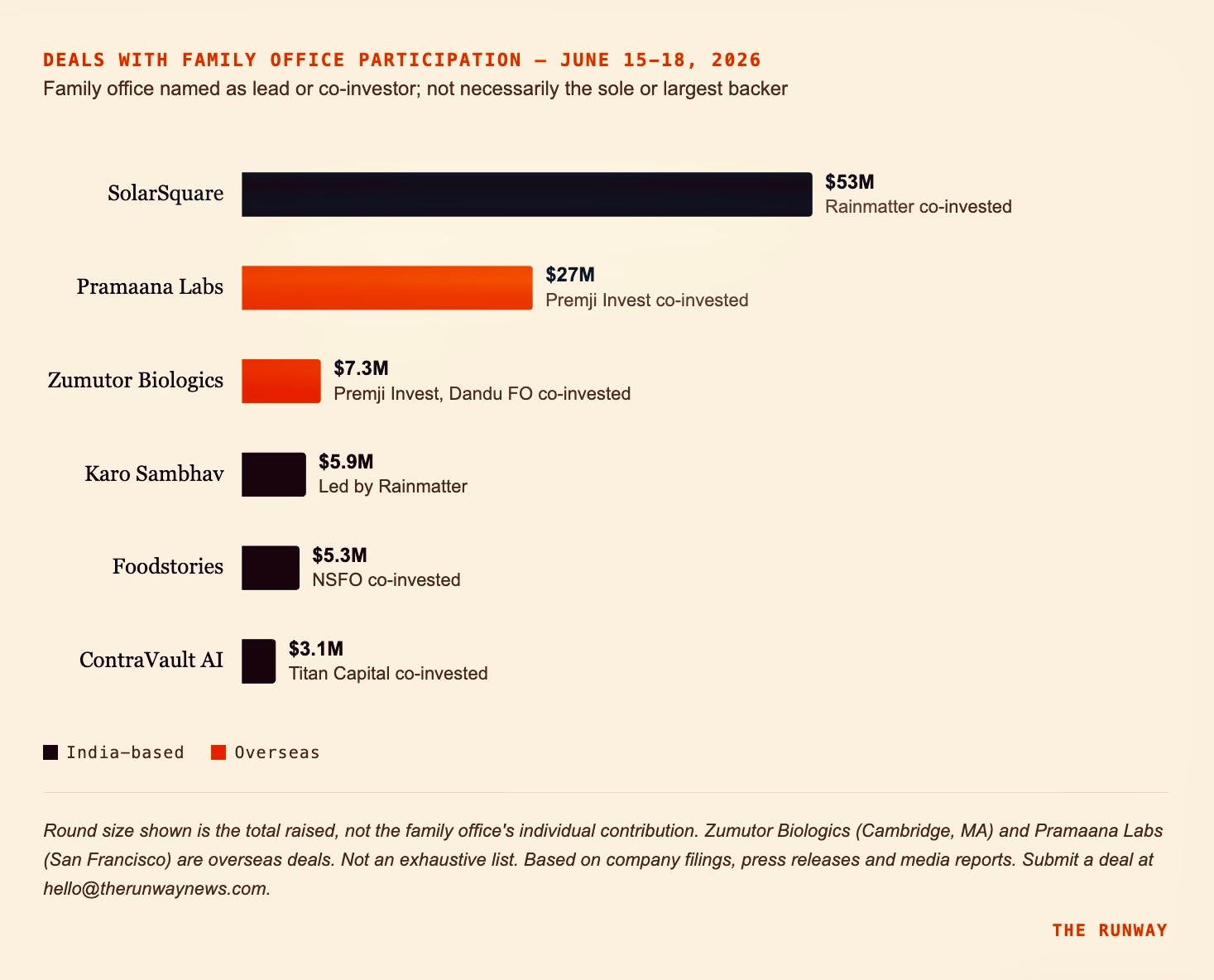
Homegrown family offices of varying sizes showed up in six deals this week, including two overseas. Overall, the investment momentum in India’s PE-VC market has picked up significantly over the last couple of weeks after a brief lull. Apart from a blockbuster datacenter investment, enterprise tech companies as a block had a decent outing. For next-generation consumer brands, it was a milestone week with a global cosmetics company swooping in to buy a homegrown personal care brand.
CtrlS Datacenters raised Rs 7,000 crore ($741 million) from Canada Pension Plan Investment Board (CPP Investments). The money, according to a statement, will be split two ways:
Rs 4,000 crore ($423.4 million) will buy a 8.2% stake in CtrlS, valuing the company pre-money at about $4.8 billion.
Rs 3,000 crore ($315.5 million) will be invested in a new joint venture to build hyperscale data centre campuses across the country. CPP Investments will own a 48% stake in the joint venture and CtrlS will hold the rest.
Founded in 2007, Hyderabad-based CtrlS runs 19 data centres across nine cities with a capacity of over 370 MW. It is adding another 4.4 GW across projects at various stages of execution and also plans to expand to the Middle East and Southeast Asia, starting with Thailand, it said in the statement. The investment from CPP Investments is the company’s first major institutional equity round, founder and CEO Sridhar Pinnapureddy told Mint, adding that it did a friends and family round four months ago which included Zerodha co-founder Nikhil Kamath.
SolarSquare, a Mumbai-based company that provides rooftop solar solutions for homes and businesses, raised $53 million in a Series C round led by B Capital. Returning investors in the round included Lightspeed, Elevation Capital, Lowercarbon Capital, Rainmatter and Good Capital.
Vetic raised $40 million in a new funding round led by existing investor Bessemer Venture Partners. Greenoaks Capital, Lachy Groom and JSW Family Office were returning investors in the round. The Gurugram-based startup provides petcare services via an omnichannel presence. The round comes a year after Vetic raised $26 million in a Series C round led by Bessemer.
TruNativ raised $30 million in a Series B round from OrbiMed. The round included a secondary component that enabled exits for early investors. The Mumbai-based company makes and retails clean-label nutrition products.
Rusk Media raised $10.5 million in a pre-Series C round led by existing investor Nazara Technologies. Info Edge Ventures, IvyCap Ventures and Audacity Ventures joined the round. The Delhi-based mobile-first digital entertainment company develops and delivers serialised social OTT video content across fiction and non-fiction genres.
Karo Sambhav raised $5.9 million in a pre-Series A round from Rainmatter. The Gurugram-based startup collects and recycles waste across e-waste, batteries, glass and other end-of-life material streams.
Sub $5 million deals: Gourmet food and lifestyle platform Foodstories raised $5.3 million led by Nikhil Kamath. RFP and tender management software developer ContraVault AI raised $3.1 million led by Chiratae Ventures. Wealth management company Crest Capital raised $3.1 million led by BEENEXT. VR training platform AutoVRse raised $2.4 million from Singularity AMC and Lumikai. Used two-wheeler marketplace Speedioo raised $1 million led by Atomic Capital.
In overseas funding deals, Wipro went shopping for a stake in an AI infrastructure company, Premji Invest joined an investor group to back cancer therapies-focused biotech and Centre Court Capital struck a deal in Paris.
Arcade.dev raised a $60 million Series A round, which IT services major Wipro joined as a strategic co-investor. The round was led by SYN Ventures and included Morgan Stanley. The San Francisco-based startup provides a secure action and authorization layer or MCP Runtime to enable AI agents to act on behalf of users in enterprises.
Pramaana Labs raised $27 million in a seed round led by Khosla Ventures. Nexus Venture Partners, Premji Invest were among the co-investors in the round. The San Francisco-based startup is building the “verification layer for AI.”
Rocapine, a Paris-based venture studio that develops wellness apps, raised a $13 million Series A round. Mumbai-based Centre Court Capital was among the investors in the round, which was led by Educapital.
Zumutor Biologics raised $7.3 million in a pre-Series B round led by existing investors Accel and Bharat Innovation Fund. Premji Invest, public markets investor Ashish Kacholia and Dandu Family Office joined the round as new investors. The Cambridge, Massachusetts-based biotech company, which operates labs in Bangalore, is developing antibody-based cancer therapies that harness NK (natural killer) cells to detect and eliminate tumours.
A consumer brand acquisition marked M&A this week. French cosmetics group L’Oreal signed an agreement to buy a majority stake in Innovist, a Gurugram-based personal care startup known for brands such as Bare Anatomy and Chemist at Play. The financial terms of the agreement were not disclosed.
Post-acquisition, the brands will sit within L’Oréal’s Consumer Products Division portfolio. Innovist was founded in 2018 by Rohit Chawla, Sifat Khurana and Vimal Bhola who will remain on board as minority shareholders.
As part of the agreement, L’Oreal has secured rights to buy out Innovist’s minority stakeholders, it said in a statement.
The startup has raised about $26 million till date from multiple investors including ICICI Venture, Sauce VC, Accel, Mirabilis Investment Trust, family offices Niveshaay Investment and 72 Ventures, and Amazon Smbhav Venture Fund. Accel exited the company last year when ICICI Venture led a $15.8 million Series B round.
Submit a deal for The Runway Briefing by replying to this email or write to us at hello@therunwaynews.com.
Recco | Notes on Culture, Craft and the Considered Life
Give Rum Another Chance
The pleasures of a good rum are often overlooked in favour of whisky, especially in India. That is a pity because rum is among the world’s most diverse spirits, capable of expressing everything from rich molasses notes to grassy, almost vegetal flavours.
It’s not as if India lacks good rum.
Goa-based Maka Zai’s limited-edition, barrel-aged Mesma rum is a case in point. Then there is Camikara, which introduced many Indian drinkers to the world of rhum agricole, a style traditionally associated with the French Caribbean. Unlike most rums, which are made from molasses, rhum agricole is distilled from fresh sugarcane juice, producing spirits that are often fresher and more aromatic. More recently, Huli Spirits pioneered India’s first jaggery rum, a category that was later joined by Amrut Distilleries.
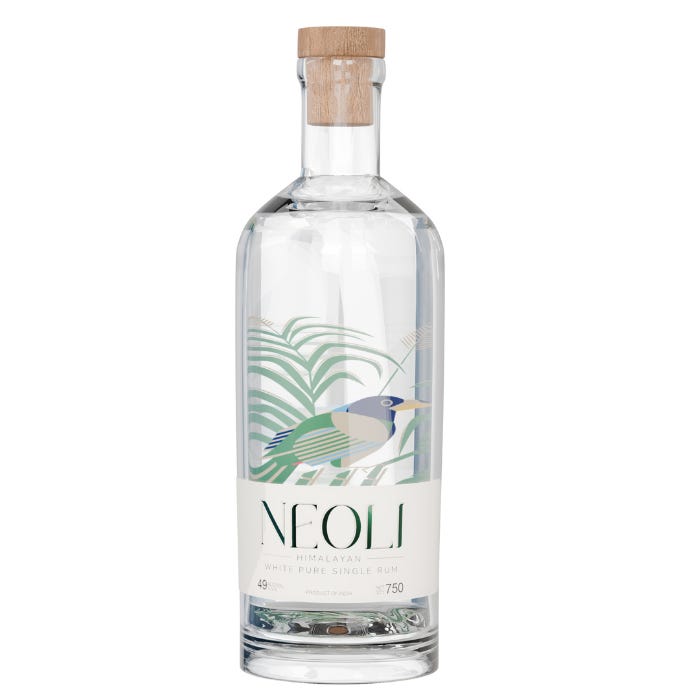
Our recommendation this week is Neoli from Himmaleh Spirits, the company behind the well-regarded Kumaon & I gin.
Neoli adapts the rhum agricole tradition to the Indian Himalayas, using sugarcane sourced from Uttarakhand. The result is a spirit that feels markedly different from the dark, sweet rums many Indians grew up drinking. More importantly, it demonstrates how Indian spirits makers are beginning to explore rum with the same seriousness that helped transform perceptions of Indian whisky over the past decade. Neoli is available in Uttarakhand, Goa and a handful of other markets.
If your bar is stocked entirely with single malts, this might be a good excuse to venture beyond whisky.
Recco is a column by Murali Menon. Murali has spent a career paying close attention to how things are made, where they come from, and why some of them endure. Every edition, one recommendation: a maker, an object, a place, a practice.
Thank you for reading The Runway. We’d love to get your feedback. Drop us a line at hello@therunwaynews.com or just reply to this email.
That comparison between Sarvam and DeepSeek hits on the exact structural issue facing sovereign AI today. Can domestic ecosystems outside the US and China realistically generate the scale required to survive the agentic era?
What’s particularly fascinating about DeepSeek’s $7.4B round is who wasn't there. Alibaba and ByteDance sat it out, and who was there, industrial non-tech heavyweights like CATL. This points to a highly coordinated, state-guided effort to integrate AI across heavy manufacturing and energy, not just apps and enterprise workflows.
If you're looking at how this massive capital surge is shifting the global balance of power and challenging Western tech, I just published an in-depth piece on the mechanics behind DeepSeek's round: https://asiaai.fyi/east-asias-ai-capital-surge-homegrown-models-challenge-west-amid-mineral-tensions/
Great analysis on Sarvam. I think anointing a “sovereign” AI had more disadvantages than benefits.
Unrelated: but I can’t wait to try this rum!