



Edition #30. Singapore’s sovereign capital went shopping this week at opposite ends of the Indian economy. GIC backed a rocket company. Temasek invested in a dairy products maker. Both are long-term bets on the country’s structural growth.
Skyroot Aerospace raised a $60 million round led by GIC and Sherpalo Ventures, both returning investors, valuing the Hyderabad-based startup at $1.1 billion. Funds managed by BlackRock, Arkam Ventures, Playbook Partners, Sanghvi Family Office and the founders of Greenko Group joined the round.
Up until 2020, India’s space sector was dominated by the state-owned India Space Research Organisation (ISRO). Subsequent policy reforms opened the doors for end-to-end commercial participation by the private sector. Skyroot was among the first to move in.
Founded in 2018 by former ISRO scientists Pawan Kumar Chandana and Naga Bharath Daka, it conducted India’s first private rocket launch from India – the Vikram-S – in November 2022. The demonstration set the ground for the company’s orbital launch vehicle, Vikram-I, which the company said is “weeks from its maiden flight.”
Skyroot is not alone in the field. Agnikul Cosmos launched its Agnibaan SOrTeD sub-orbital demonstrator a couple of years ago. Pixxel is building a constellation of hyperspectral imaging satellites. India now has an estimated 400 spacetech startups.
Spacetech funding in 2026: In January, IISc-incubated space surveillance and intelligence startup Digantara onboarded Reliance Industries as the lead investor in a $50 million Series B round. Aule Space, which is building autonomous satellites that can dock with and service other satellites in orbit, raised $2 million from Pi Ventures. In March, Bellatrix Aerospace, which manufactures satellite propulsion systems, raised a $20 million round led by Cactus Partners.
India’s space economy is valued at approximately $8.4 billion and the government target is to grow it to $4-45 billion over the next 8-10 years. Orbital capability is central to that ambition.
Milky Mist Dairy Food raised Rs 482 crore (approximately $51 million) in a pre-IPO round from Temasek arm Jongsong Investments. The transaction, according to reports, valued the Erode, Tamil Nadu-based company at approximately Rs 9,300 crore (just shy of $1 billion). The round comprised a primary infusion of Rs 357 crore and a secondary component of Rs 125 crore, in which founders Sathishkumar T and Anitha S sold shares at Rs 139.76 per share.
The company filed draft papers with markets regulator SEBI for a Rs 2,035 crore listing in July last year.
Milky Mist was a 30-year bootstrapped company prior to this round.
The company doesn’t sell liquid milk. Its business is built entirely on value-added dairy products such as paneer, ghee, curd, butter, cheese and ice cream, which positions it in higher-margin territory.
Revenue from operations (consolidated) grew 29% to Rs 2,349 crore in FY25 from Rs 1,822 crore in FY24. Profit after tax rose 2.4x to Rs 46.07 crore from Rs 19.44 crore. EBITDA margin expanded to 13.2% (Source: Milky Mist DRHP)
The proposed Rs 2,035 crore IPO consists of a fresh issue of Rs 1,785 crore and an offer for sale of Rs 250 crore by the promoters. The Temasek pre-IPO placement, if completed, will reduce the fresh issue size accordingly.
The Milky Mist deal is the latest in a string of large consumer bets Temasek (also happens to be an investor in Skyroot Aerospace) has made in India. Recent transactions include a minority stake in packaged snacks maker Haldiram’s and an investment in cloud kitchens company Rebel Foods.
Bets on long-term structural growth: Milky Mist sits within India’s organised food and consumer products sector, which is still deeply fragmented and unorganised. The dairy segment is estimated at Rs 10.8 lakh crore and the value-added dairy products segment, in which Milky Mist operates, accounts for 51% and is projected to grow at 12% annually (Source: 1Lattice industry report referenced in the Milky Mist DRHP).
Temasek’s bet is that organised, branded players will capture a growing share of that expansion as incomes rise and cold chain infrastructure improves.
Skyroot falls within India’s emerging deep technology and space economy, nascent as a private sector play but underpinned by decades of state investment through ISRO. The addressable market is global: launch services, satellite deployment and defence applications. But it’s not a market that yields returns quickly. Developing and proving orbital launch capability requires years of engineering, repeated testing and regulatory navigation. The capital cycle is long and the technology risk is high.
As a sovereign wealth fund managing Singapore’s long-term foreign reserves, GIC represents the deep and patient long-term capital critical for the scaling of companies such as Skyroot. The bet is that India’s private space sector will produce commercially viable launch capability within a decade. Its return to Skyroot’s cap table in this round, deepening an earlier commitment, signals the conviction.
The Week in Deals
Early-Stage Consumer Bets; Fintech Delivers Exits
Apart from Skyroot and Milky Mist Dairy Food, on-demand household help services scored again along side a bunch of early stage consumer startups across skincare, apparel and women’s hygiene. A homegrown sports-focused fund went shopping overseas. And a fintech IPO delivered profitable exits for early investors.
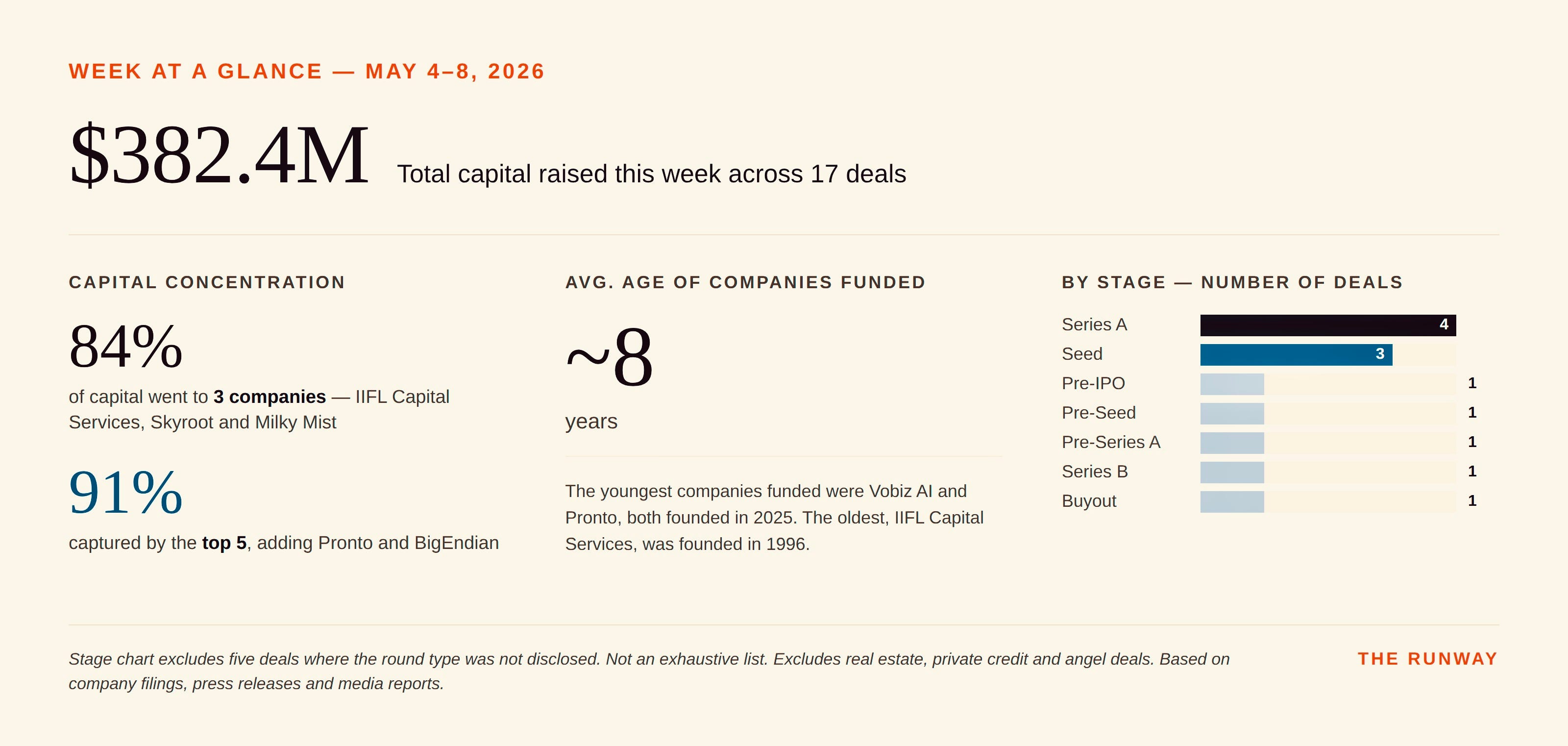
IIFL Capital Services approved a preferential allotment of 5.71 crore shares to Fairfax India in lieu of a primary capital infusion of Rs 2,000 crore (approximately $212 million). The transaction will increase Fairfax India’s ownership of the company to 41.8%, triggering an open offer for an additional 26% mandated under SEBI regulations.
IIFL Capital Services, according to regulatory filings, will issue shares to Fairfax India affiliate FIH Mauritius Investments at Rs 350 per share, increasing the latter’s stake from the existing 27.18% to 38.47%.
Another Fairfax India affiliate, HWIC Asia Fund, currently holds an additional 3.33% stake.
The Canadian investment firm intends to raise its overall stake to a minimum of 51% “through a combination of transactions including a preferential allotment of equity shares, an open offer, and arrangements with the existing promoters,” said the filing.
IIFL Capital Services, earlier known as IIFL Securities, provides wealth management and institutional brokerage services.
Pronto expanded its Series B financing round to $45 million after securing an additional $20 million investment from Physical Intelligence founder Lachy Groom.
The fresh capital valued the Bengaluru-based instant household services startup at $200 million, marking a twofold jump in valuation in roughly a month.
The new infusion followed the initial close of the company’s Series B round at $25 million. Investors in the initial tranche included Epiq Capital, Glade Brook Capital Partners, General Catalyst and Bain Capital Ventures.
PlayReplay raised $12 million in a funding round led by Alfvén & Didrikson (A&D). Parth Jindal-anchored Centre Court Capital, a Mumbai-based venture capital firm, was part of the investor group that participated in the round.
PlayReplay, based in Stockholm, is an AI-powered intelligence platform for racquet sports.
Centre Court Capital, which focuses on sports-tech and gaming, raised Rs 410 crore (under $50 million) for its debut fund last year. Last month, the firm co-led a seed round in Bangalore-based gaming studio Spill Games.
BigEndian Semiconductors raised $6 million in a pre-Series A round led by IAN Alpha Fund, with participation from Vertex Ventures SEA & India and IvyCap Ventures. The Bangalore-based fabless semiconductor startup develops custom integrated circuits and SoC solutions tailored for surveillance and imaging applications, with its in-house chip forming a key part of its broader product roadmap.
Chosen raised $5 million in a Series A round led by Fireside Ventures. BOLD, L’Oréal’s venture capital arm and Alkemi Growth Capital participated in the round along with high networth individuals including CaratLane co-founder Avnish Anand. The Chennai-based startup develops and retails skincare and hair care products.
Other deals this week:
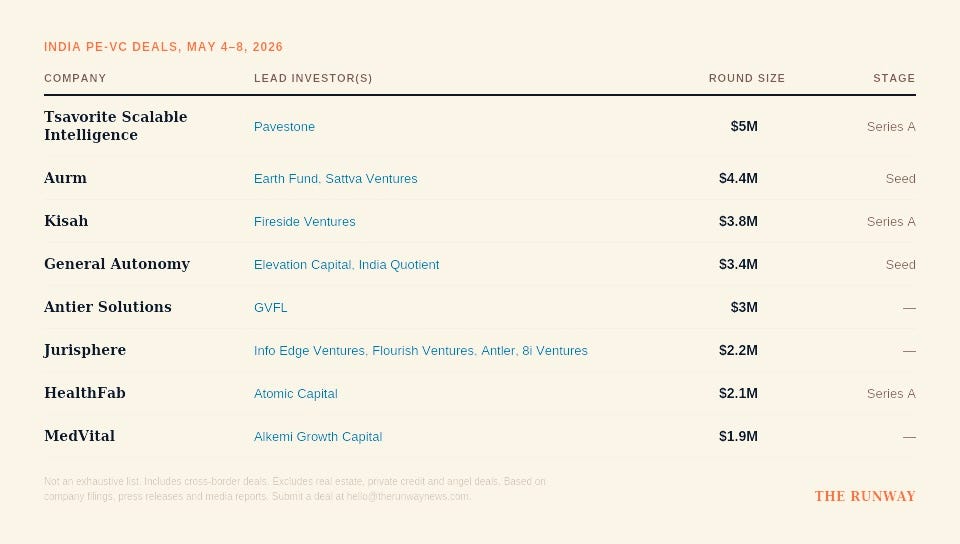
Sub $1 million deals: AI-first telephony infrastructure platform Vobiz, and Blunav, a startup building cloud-native software solutions for airport management, raised $1 million each from Piper Serica. Banza App raised $1 million in pre-seed round led by Campus Fund.
In exit moves, digital lender Kissht’s IPO sailed through comfortably. The Mumbai-based company listed on the bourses on Friday at Rs 190 a share (NSE data), an 11% premium on its offer price of Rs 171 a share. The Rs 926 crore offering included a Rs 76 crore offer for sale. Among Kissht’s early backers, Endiya Partners, which invested in the company’s seed round in 2017, sold part of its stake realising 4.7x on its initial investment.
“Kissht built Rs 5,956 Cr in AUM on approximately Rs 500 Cr of external equity raised over nine years of partnering. Peers in the category raised higher levels of capital (based on industry data) to reach comparable or larger scale. Kissht is Fund I’s anchor exit,” Endiya managing partner Sateesh Andra wrote in a blog post on Friday.
VenturEast Proactive Fund LLC sold 2.64 lakh shares at a multiple of 10.9x, while Ventureast Proactive Fund II came in at 3.2x. Both investors are sitting on sizable paper gains at the current stock price.
Submit a deal for The Runway Briefing by replying to this email or write to us at hello@therunwaynews.com.
Recco | Notes on Culture, Craft and the Considered Life
Titan Goes Diving
Swiss watches are about to get cheaper in India. The EFTA trade pact will bring down import duties incrementally, and Titan — the only serious Indian watchmaker, and the world’s fifth-largest by volume — isn’t waiting to see how that plays out. In the last six months alone, it has brought in the niche Swiss brand Auguste Reymond and is this month introducing Roamer, a mid-range Swiss label with a long history.
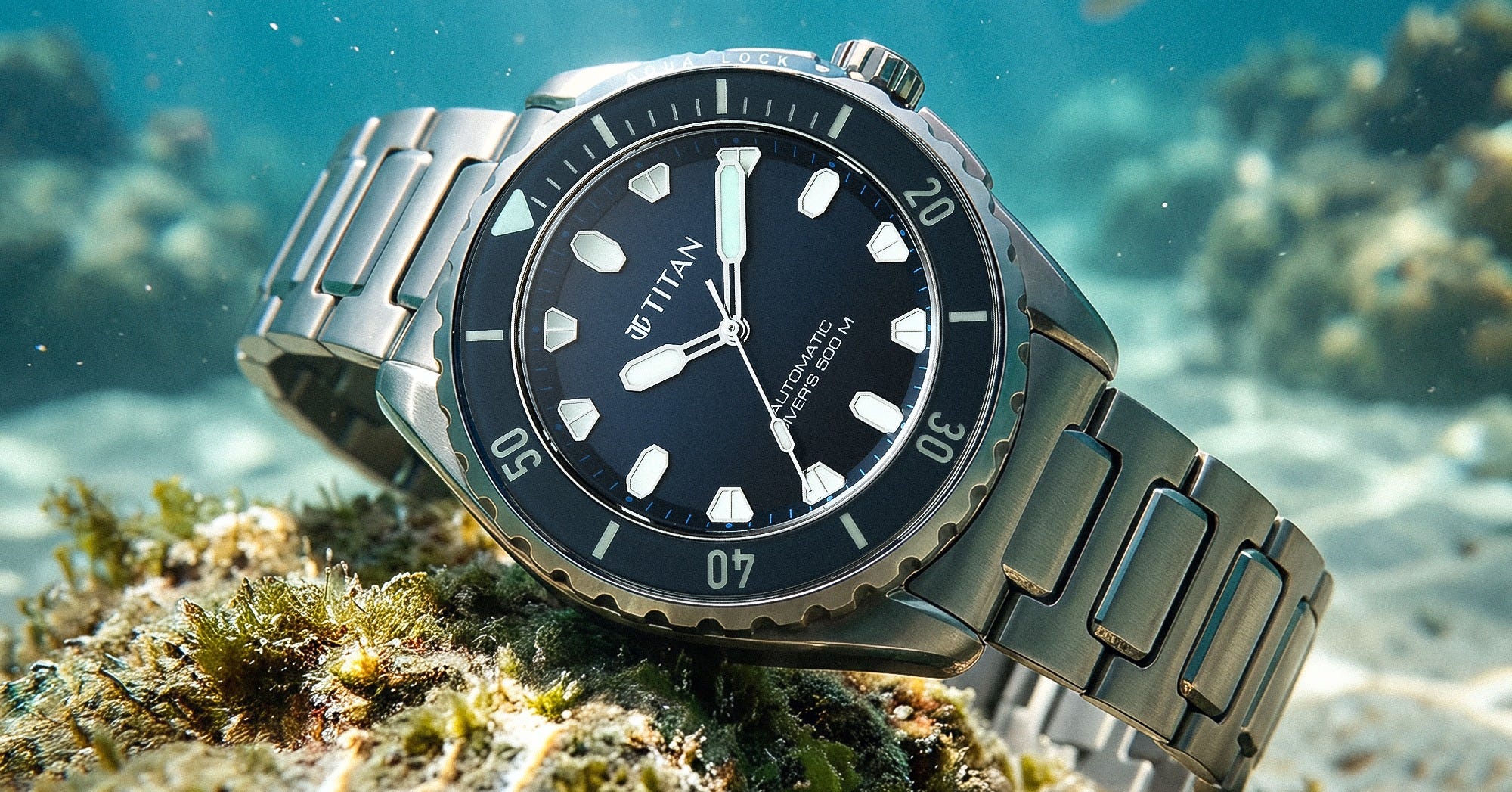
It has also been pushing its own name further upmarket. The latest signal is Zero Hour, a new performance-sports line built around a diver. The collection has twelve models ranging from 100 to 500 metres of water resistance.
At the top sits the 500M Professional Diver’s Automatic — a watch designed to be taken seriously. The credentials are in order. ISO 6425 certified. Grade 2 titanium case. A 120-click unidirectional bezel with an Aqua Lock mechanism. Sapphire crystal with anti-reflective coating. Lume that actually works underwater. The movement is Titan’s own — Calibre 7AC0, an in-house automatic. It ships on a titanium bracelet with an FKM rubber strap as backup, both on quick-release.
Production is limited to 500 units per variant. Price is ₹76,000 to ₹78,000. That is serious money for a Titan, and very much the point.
Recco is a column by Murali Menon. Murali has spent a career paying close attention to how things are made, where they come from, and why some of them endure. Every edition, one recommendation: a maker, an object, a place, a practice.
Thank you for reading The Runway. We’d love to get your feedback. Drop us a line at hello@therunwaynews.com or just reply to this email.