



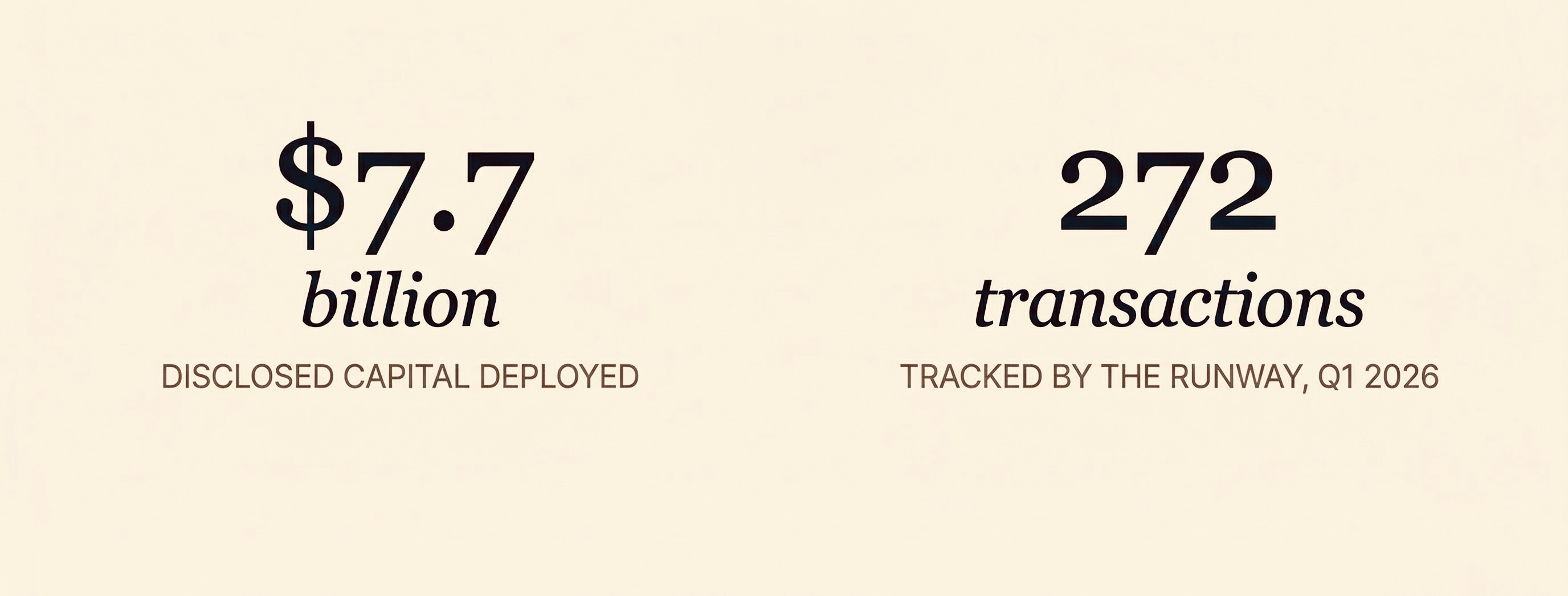
Edition #25. The raging conflict in the Middle East is as much a concern for India’s private equity and venture capital market as anywhere else in the world. That said, India-based and India-focused investors put $7.7 billion to work in the opening quarter of 2026 across 272 transactions tracked by The Runway in Signals | Q1 2026, our first quarterly report on PE-VC activity in India.
The monthly deal activity tells a more nuanced story. January reported 99 deals worth $1.2 billion (disclosed capital) — a steady, broad-based start to the year. February closed at 96 deals and $2.2 billion, inflated significantly by a single transaction — Blackstone’s $600 million bet on AI infrastructure company Neysa. March logged 77 deals worth $4.3 billion. But two transactions accounted for $2.8 billion — the buyout of cricket franchise Royal Challengers Bengaluru by a consortium that included Blackstone and Bolt Ventures, and Nxtra Data’s billion dollar funding round this week (scroll down to the Week in Deals section for more).
Overall, 11 mega deals ($100 million and above) accounted for 63% of the capital deployed during the quarter.
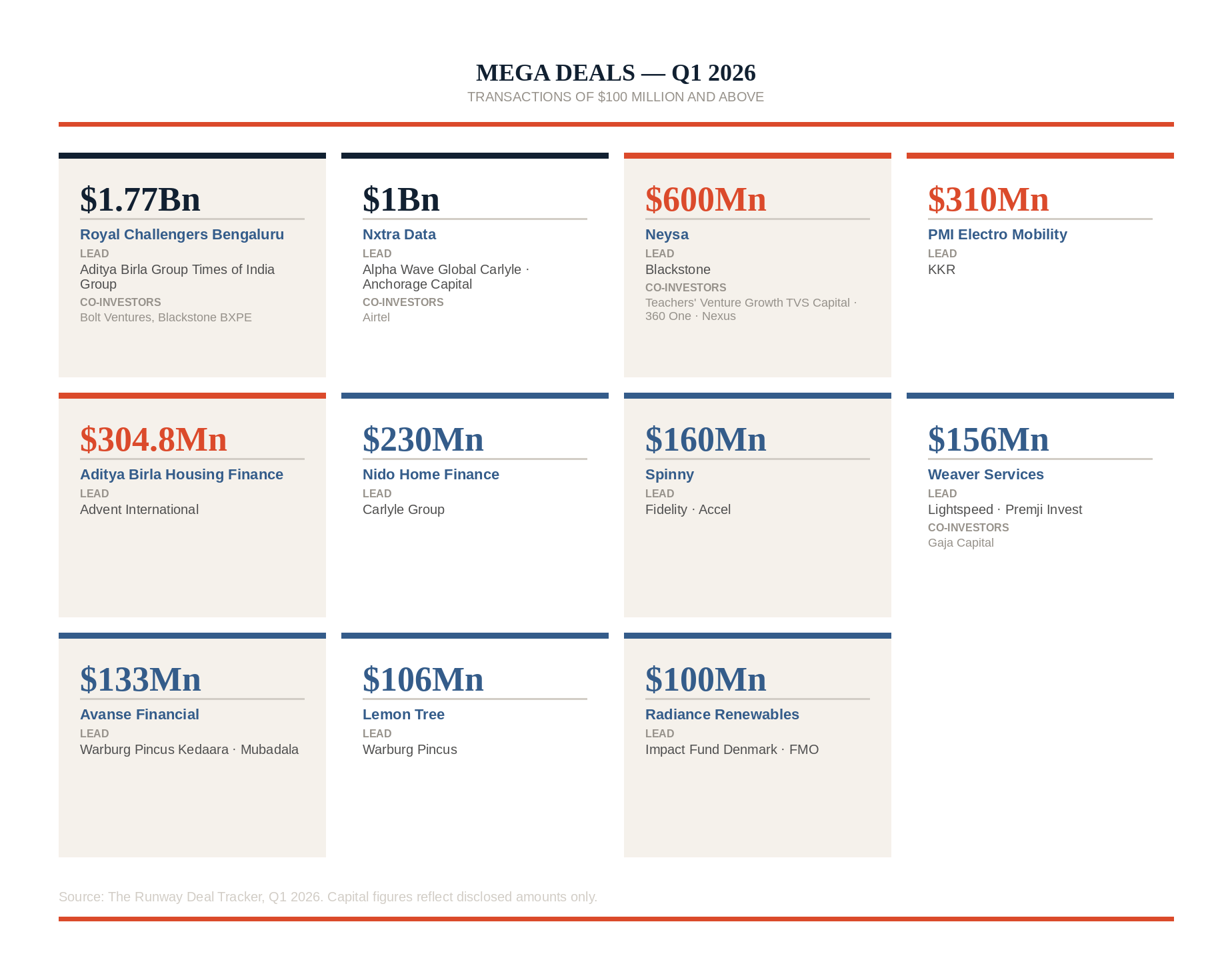
General Atlantic’s acquisition of a 7% stake in Balaji Wafers at a valuation of $3.8 billion would also be counted as a mega deal but wasn’t included in the tally because the deal size was not disclosed.
More than investments, the war disrupted IPO activity — a lucrative liquidity route for PE-VC investors over the past two years. FII participation in new listings dipped significantly in March and several companies deferred listing plans. It didn’t help that even before the war erupted, a handful of IPOs from PE-VC-backed companies this year had disappointing outings — Fractal Analytics listed at a 3% discount to its offer price; Shadowfax Technologies, Amagi Media Labs and Aye Finance failed to impress the markets.
Across the quarter, the median deal size held at $5 million. In terms of stage distribution, 149 tracked deals were pre-seed through Series A. The median Series A cheque was $7.6 million.
AI-related deals were the quarter’s defining sub-theme, and they accelerated month-on-month in both deal count and capital. January saw 29 AI-related transactions totalling $335 million in disclosed capital. February and March reported 35 deals and 30 deals respectively across infrastructure, voice AI, vertical AI applications and semiconductor design.
In total, 94 of the 272 tracked transactions had a direct AI or AI-related dimension, representing approximately $2.5 billion in disclosed capital.
The investor profile on cap tables continued to shift. Family offices and HNIs participated in at least 27 tracked deals, frequently as lead investors. Premji Invest buffed up its technology portfolio, both in India and overseas; Lohia Family Office picked up stakes in a textiles company; Sharrp Ventures backed a sports apparel company and a clean label snacks brand; and Ashish Kacholia backed companies in precision oncology and automotive electronics.
Corporate and strategic investors made moves as well. Reliance Industries bet on spacetech; Unilever Ventures backed a fragrances startup; Hero MotoCorp invested in an EV company; and, of course, the Aditya Birla Group led the Royal Challengers Bengaluru buyout.
Co-investment activity was high: 168 of 272 tracked deals involved at least one co-investor, and 81 had three or more participants. Several deals attracted ten or more investors, a pattern concentrated in the AI-related and consumer categories.
The sector analysis in this report reveals distinct investment patterns: a 13-deal spacetech cluster spanning propulsion systems to drone delivery; a 12-deal voice AI cluster; a four-company wearables category; and housing credit as a distinct PE thesis attracting six global fund managers.
As global geopolitical tensions continue into the second quarter, investment momentum is likely to slow further. Investors, both global and homegrown, will be inclined to pause fresh commitments, particularly large-ticket ones. Exits via the public markets remain a less attractive option in the medium term though secondaries will remain in play opportunistically.
→ The complete Signals | Q1 2026 report drops on Tuesday, April 7. Here’s a snapshot of what’s under the hood:
The secondaries engine — EQT’s $3.2 billion acquisition of Coller Capital made secondaries the structural story of the quarter globally. We map what that means for India.
Fund formation — More than twenty new funds launched or closed in Q1 — from Peak XV’s $1.3 billion across three vehicles to sub-Rs 300 crore deeptech and B2B seed funds. Find out where limited partner conviction is concentrating.
Five behavioural themes — Housing credit attracted six global PE firms in a single quarter — independently, not in sequence. The EV value chain was funded end-to-end for the first time. AI is operating as three structurally different investment theses.
Sports as a PE asset class — The RCB acquisition was not a one-off. The same quarter saw Otro Capital raise $1.2 billion for the largest-ever first-time sports buyout fund, and KKR acquire Arctos Partners — the largest institutional sports investor globally — for $1.4 billion. We place India’s IPL franchise market in that global context.
Co-investment clubs and family offices — Who is travelling with whom, and what the recurring pairs signal about de-risking strategies. Plus: the multiple appearances of family offices as lead investors — not passive co-investors.
Two regulatory shifts — The Cabinet’s amendment pertaining to Chinese investments, and SEBI’s overhaul of AIF reporting.
All 272 tracked deals — A full appendix table of every transaction in the tracker — company, sector, lead investor, round size, stage, and month.
Signals | Q1 2026 is available for purchase. It publishes Tuesday, April 14.
The Week in Deals
Nxtra’s $1 Bn Haul; Xponentia leads Palmonas’ Series B
Private equity firm Xponentia Capital expanded its consumer portfolio with a bet on jewellery startup Palmonas. AI continued to attract mega bucks. And, a Kolkata-based startup pulled in a bunch of investors.
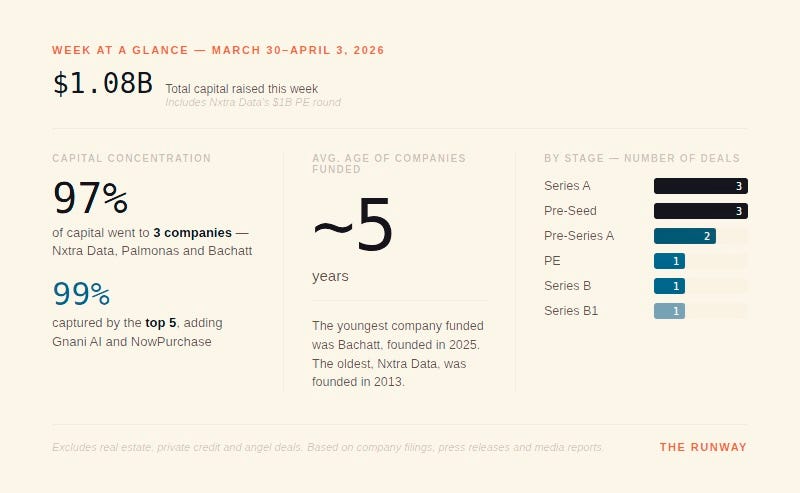
Nxtra Data, Bharti Airtel’s data center subsidiary, raised a $1 billion commitment from a private equity investor consortium led by Alpha Wave Global and The Carlyle Group. The round values the Delhi-based company at $3.1 billion, post-money.
Alpha Wave Global is investing $435 million; returning investor Carlyle is bringing in $240 million and Anchorage Capital is deploying $35 million.
The remainder will be invested by Airtel, which will continue to hold a controlling stake in the company, Bharti Airtel said in a regulatory filing.
Carlyle entered Nxtra in 2020, investing $235 million for an approximately 25% stake. Nxtra was valued at $1.2 billion, post-money at the time.
India’s bid to emerge as the world’s AI infrastructure hub is attracting a variety of investors from homegrown conglomerates to global technology companies and private equity firms. In November last year, TPG committed to investing $1 billion in company TCS’ HyperVault project, which aims to build gigawatt scale AI data centers in the country. TPG is expected to own between 27.5% and 49% of the TCS subsidiary.
Palmonas raised $40 million in a Series B funding round led by Xponentia Capital and Vertex Growth Fund. Existing investor Vertex Ventures Southeast Asia & India joined the round. The Pune-based omnichannel jewellery brand retails demi-fine and nine-carat gold jewellery.
Bachatt raised a $12 million Series A round led by Accel. Existing investors Lightspeed and Info Edge Ventures participated in the round. The Delhi-based startup offers a daily savings and wealth management platform that targets small merchants and self-employed individuals.
Gnani.ai raised $10 million as part of an ongoing Series B round led by Aavishkaar Capital. Existing backer Info Edge Ventures participated in the round. The Bengaluru and San Francisco-based voice-first agentic AI startup also counts Samsung Ventures among its early backers.
NowPurchase raised $8.6 million in a funding round led by Bajaj Finserv. Info Edge Ventures, Orios Venture Partners, REAL Group - GK TMT and VC Grid participated in the round. The Kolkata-based startup offers a full-stack procurement platform for metal scrap, alloys and additives required by metal manufacturers.
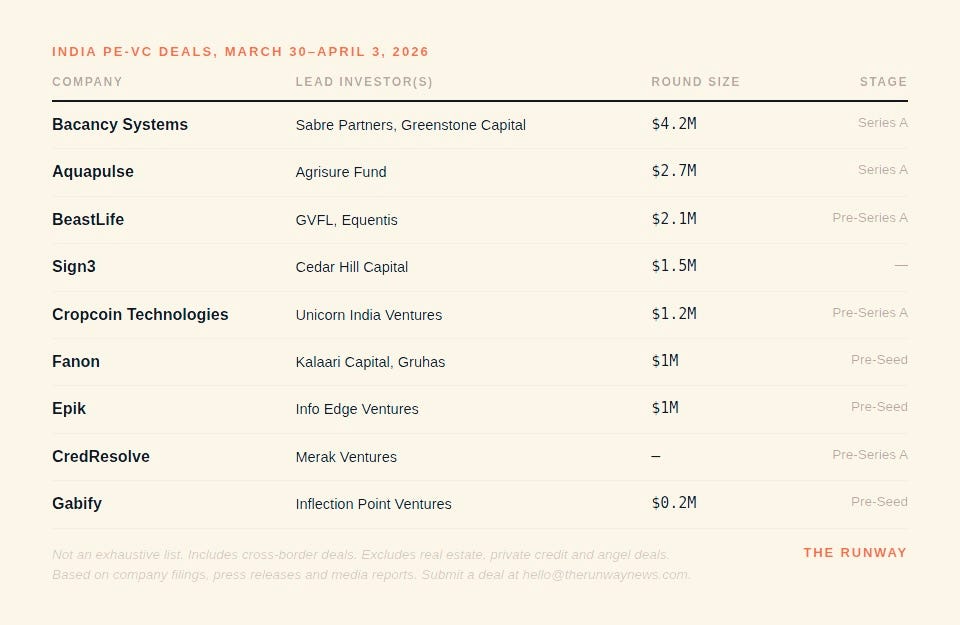
Other funding deals this week:
Offshore forays: Elevation Capital joined an investor consortium in a $44 million round for San Francisco-based AI-led product design platform Noon. Other investors in the round included Chemistry, First Round Capital and Scribble Ventures.
In M&A, Blackstone-backed EPL (formerly known as Essel Propack) is merging with Indorama Ventures-owned Indovida India to create a $2 billion packaging business. Post-merger Indorama Ventures, which owns a 24.9% stake EPL, will own 51.8% of the combined entity, while Blackstone will own 16.6%, according to a regulatory filing. Blackstone entered EPL in 2019, acquiring a 75% stake for approximately $460 million. It sold a 24.9% stake to Thailand-based Indorama Ventures in May last year.
Submit a deal for The Runway Briefing by replying to this email or write to us at hello@therunwaynews.com.
Recco | Notes on Culture, Craft and the Considered Life
A Single Malt From the Edge of the Map

The last two decades have proved that Scotland does not have a monopoly over single malt whisky. Japan, Australia, Taiwan, Sweden and India now make excellent malt whisky. Vietnam, Thailand and Indonesia are among the most recent entrants into this still rather exclusive club. But none of their drams quite stir curiosity like one distilled in the Faroe Islands.
The Faroes, a self-governing territory within the Kingdom of Denmark, sit in the North Atlantic between Iceland and the Shetland Islands. Barely 50,000 people live on this 18-island archipelago. Three years ago, some of them set up a distillery called Faer Isles on Streymoy Island. Its inaugural release is scheduled for later this year.
Partly crowdfunded by whisky enthusiasts, Faer Isles matures its spirit in an opnahjallur — a traditional structure with slatted walls used to cure meat and fish.
The open design exposes the casks directly to the island air. The Faroes resemble Scotland in landscape, but the climate is more humid and far more stable in temperature.
Whether that combination produces a whisky that can stand alongside its more established peers will only become clear once the first bottles are poured. For now, the appeal lies in the setting — and in the fact that single malt whisky continues to find new homes in unlikely places.
Recco is a column by Murali Menon. Murali has spent a career paying close attention to how things are made, where they come from, and why some of them endure. Every edition, one recommendation: a maker, an object, a place, a practice.
Thank you for reading The Runway. We’d love to get your feedback. Drop us a line at hello@therunwaynews.com or just reply to this email.
Waiting for the entire report! Interesting data points