


In Edition #18, we dive into what AI deals in January and the Fractal Analytics IPO say about how India’s AI narrative is evolving. We also look at how dealmaking in the broader market unfolded, from several big plays in the consumer sector to key liquidity events.
Lede | By Shubham Sharma
Utility Defines India’s AI Narrative

Fractal Analytics pitched itself as India’s first homegrown AI-focused company to go public. Then it had to explain what that meant.
The Mumbai-based enterprise analytics company set a price band of Rs 857-900 per share for its initial public offering (IPO), which opened on February 9, targeting Rs 2,834 crore (about $312.5 million) against the initially planned Rs 4,900 crore.
“Investors don’t understand AI right now,” CEO Srikanth Velamakanni told Reuters, on the decision to trim the size of the IPO.
At its close on February 11, the IPO was fully subscribed. Qualified institutional investors subscribed 4.18 times, non-institutional investors 1.06 times and retail buyers were at 1.03 times. The response could be described as calibrated interest.
Fractal isn’t an AI company in the way most parts of the world use the term. It’s an enterprise analytics firm that uses data science and AI as core tools. The company’s revenue model is anchored in consulting engagements and long-term contracts with Fortune 500 clients. The business model, designed around embedded analytics and machine learning inside enterprise workflows, is AI as utility.
It’s also the model that’s popular with private equity and venture capital investors in India right now.
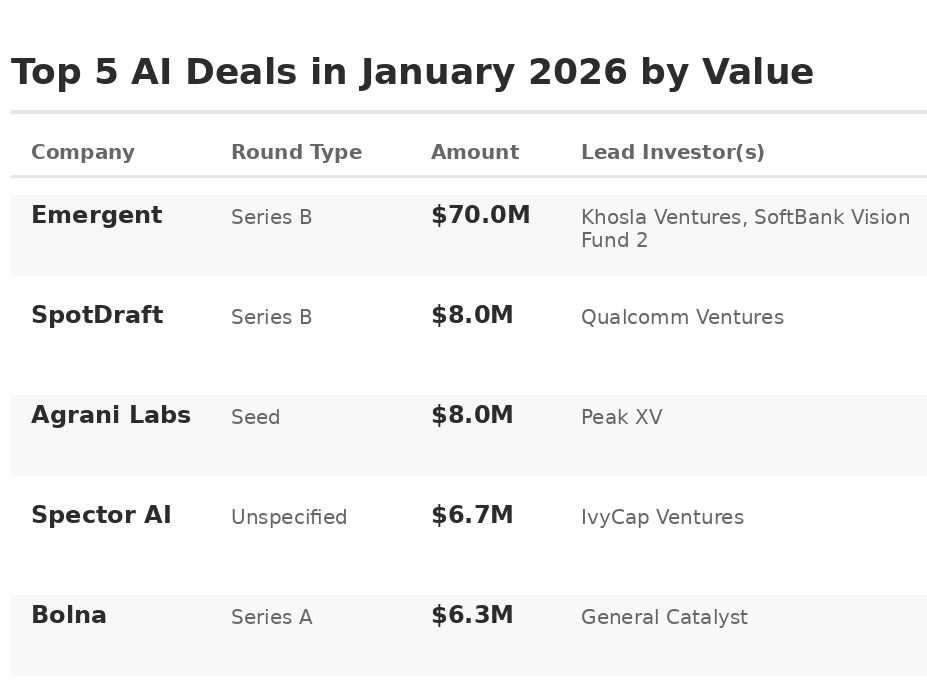
The common thread within the cluster of AI or AI-related deals announced in January is less about sophistication of models and more about the job AI is being hired to do. Out of the 15-odd deals in January, the majority were in enterprise software, workflow automation and vertical SaaS.
Let’s start with the voice AI companies. Arrowhead, which is building voice agents for the fintech sector, raised $3 million in a seed round led by Stellaris Venture Partners. Bolna raised $6.3 million in a Series A round led by General Catalyst to build voice agents for enterprises. Ringg AI, another voice AI startup, raised a $5.5 million Series A led by Arkam Ventures.
These companies are deploying voice systems that behave like employees. They handle service calls, follow prescribed workflows, and plug into CRM and financial systems. What matters is whether the AI converts, recovers revenue, or resolves an issue — not how clever the conversation sounds. That shift is changing the economics of AI companies. Once AI is treated as operational capacity rather than experimental technology, reliability and unit economics start to matter more than raw intelligence.
The same pattern shows up in vertical AI and enterprise SaaS. SpotDraft, which makes legal contract lifecycle management software, raised $8 million in a Series B round from Qualcomm Ventures. Mysa, a finance and accounting ERP platform, raised a $3.4 million pre-Series A led by Blume Ventures and Piper Serica. They’re both embedding themselves in specific workflows, anchoring their value to clear KPIs and budgets. This is AI designed to be lived with daily.
Bets like Agrani Labs and Emergent point to a second-order evolution: the rise of tools built to run and manage AI systems in production, not just train them. Agrani Labs, which raised $8 million in a seed round led by Peak XV Partners, is building AI GPU infrastructure with a focus on making GPU compute more accessible for Indian AI companies. Emergent pulled in $70 million in a Series B led by Khosla Ventures and SoftBank Vision Fund 2 for its AI-native development tools for code generation. Put together, these deals suggest that AI’s next phase is set to be defined by durability.
The companies attracting serious capital now are the ones making AI boring, dependable and hard to remove. That’s usually the moment when a technology stops being a story and starts becoming a utility.
All of this probably implies a faster path to profitability and higher capital efficiency. It could also imply lower venture-scale multiples (compared to Silicon Valley). That’s not the narrative that dominates the AI discourse globally. But, it might be the one that builds sustainable businesses with a clear path to liquidity for private capital investors.
The deals referenced in this article are based on disclosed funding rounds in January 2026. For the full breakdown of deals for the month, write to us to hello@therunwaynews.com.
The Week in Deals
HUL Shakes Up Nutraceuticals; Samara Exits Fund II
It’s been a buzzy week for the consumer sector. FMCG giant Hindustan Unilever stirred up the nutraceuticals market with two simultaneous deals. Liquidity remained in focus for PE-VC investors, with some notable deals struck during the week.
➝ Consumer bets
Hindustan Unilever (HUL) announced two deals this week, both in the nutraceuticals category. It exited Nutritionalab, better known as Wellbeing Nutrition, and doubled down on Zywei Ventures, which retails its products under the OZiva brand.
HUL is buying an additional 49% in OZiva for a cash consideration of Rs 824 crore (about $90.8 million), whereby Zywei will become a wholly owned subsidiary. It acquired a 51% stake in OZiva in 2022 for Rs 264 crore in a primary and secondary transaction and was committed to acquiring the remaining 49% stake within 36 months.
OZiva’s early backers include Z47 (then Matrix Partners India), Titan Capital and Eight Roads Ventures. Z47 led a $5 million Series A round in 2020. In 2021, Eight Roads Ventures led a $12 million Series B round.
HUL is also selling its 19.8% stake in Wellbeing Nutrition for Rs 307 crore ($33.8 million). It acquired the stake in 2022 for Rs 70 crore. The buyer is Mumbai-based pharma company USV.
USV is acquiring a 79% stake in Wellbeing Nutrition in an all-cash transaction that values that company at Rs 1,583 crore. Early backer Fireside Ventures, which led a $2.2 million Series A round in 2021, is also booking an exit.
In other notable consumer deals, Supertails raised a $30 million Series C led by Venturi Partners. Nippon India Alternative Investments, Titan Capital, and existing investors Fireside Ventures, RPSG Capital Ventures, Sauce VC and Saama Capital participated in the round. The company, which provides veterinary services and pet supplies, is riding a growing wave for pet care related services and products in the country as pet ownership expands in urban markets.
Elixiir Foods raised $9 million in a funding round led by 3one4 Capital. Incubate Fund Asia joined the round. The company is building an omnichannel platform for sourcing and retailing fresh produce across dairy, meat, daily essentials and frozen foods.
In smaller consumer deals, homeware brand Nester raised $2 million in a pre-Series A round led by Fireside Ventures and OTP Ventures. Pet nutrition startup Benny’s Bowl raised $1.4 million in a pre-Series A round led by Atomic Capital. Confectionary maker GoDesi raised $2.8 million in a Series B round led by Enrission India Capital.
➝ Liquidity in focus
Samara Capital sold its stake in facilities management company SMS Integrated Facility Services to SILA, a real estate and business services platform backed by Norwest Venture Partners. The all cash transaction values SMS at about Rs 270 crore (enterprise value), according to media reports.
Samara entered SMS in 2017, acquiring a nearly 100% stake. The sale enables the private equity firm to completely exit its Fund II (vintage 2014) portfolio.
“Fund II delivered an overall gross internal rate of return of approximately 25 percent on an investment base of over INR 3,000 crore. With an average holding period of 5.5 years, the fund generated more than INR 7,500 crore in value for investors and co-investors, with all ten investments delivering positive returns,” the firm said in a statement.
The mid-market focused investor is currently raising commitments for its third India-specific fund. In early 2023, in one of the largest multi-asset secondary transactions at the time, it raised a $150 million continuation fund backed by TR Capital. The continuation fund allowed it to roll-over its Fund II stakes in portfolio companies Sahajanand Medical Technologies, FirstMeridian Business Services and Paradise Food Court Private Limited.
Morgan Stanley Private Equity Asia and Fulcrum Venture India exited their stakes in Southern Health Foods (SHFPL), which retails packaged healthy food under the Manna brand. Their stakes were acquired by Reliance Industries’ FMCG subsidiary Reliance Consumer Products. The Reliance arm acquired a 100% stake in SHFPL for Rs 156.42 crore (around $17.2 million), it said in a regulatory filing.
Chennai-based Fulcrum led a Rs 30 crore investment in SHFPL in 2015.
Morgan Stanley Private Equity Asia entered in 2018, investing Rs 152 crore. It has been looking to sell its stake in the company for some time and approached several strategic investors, according to a Mint report.
➝ Other notable deals
Radiance Renewables, the solar power renewable energy company backed by Eversource Capital, raised $100 million in a growth round from Danish government backed Impact Fund Denmark and Dutch developmental finance bank FMO. The two invested $50 million each. The capital infusion will catalyse $300 million in private sector debt and enable the company to build and operate an additional 926MW of new solar power across India.
IDfy raised Rs 476 crore ($53 million) in a Series F round led by Neo Asset Management. Blume Ventures, Analog Capital, Elev8 Venture Partners, IndiaMART InterMESH Limited, and Kae Capital participated in the round. The transaction is a mix of primary and secondary capital with undisclosed early investors booking exits from the regulatory-tech company.
Olyv raised $23 million in a Series B round led by The Fundamentum Partnership and SMBC Asia Rising Fund. The lending platform, earlier known as Smartcoin, offers small-ticket personal loans to small merchants and salaried and self-employed individuals.
Pandorum Technologies raised a $18 million Series B round led by Protons Corporate. Galentic Pharma, Ashish Kacholia, Avinya Fund and the Burman family office participated in the round. The biotech company, which has operations in the US and India, is a regenerative medicine company that blends biology and engineering to design therapeutic products for health conditions such as corneal dystrophies, lung-related disorders and liver disease. Earlier investors in the company include IAN Fund, Flipkart co-founder Binny Bansal and Kotak Investment Advisors.
Showroom B2B, an apparel sourcing platform for brands and retailers, raised Rs 150 crore ($16.5) million in a Series A round led by Cactus Partners. Zephyr Peacock India and existing investors Jungle Ventures, Accion Ventures Lab, and NBD Ventures participated in the round.
Bertelsmann Investments (BI) acquired a 80% stake in logistics marketplace LetsTransport. The deal marks the launch of Bertelsmann Next, BI’s growth investments unit, in India. “LetsTransport… now as part of Bertelsmann Next India.. will also work with other Bertelsmann and BII portfolio companies including Shiprocket to explore mutual collaboration opportunities,” Bertelsmann India Investments (BII) managing director Pankaj Makkar said in a statement. BII first invested in LetsTransport in 2018.
Sub-$5 million deals: Smart mobility products company Six Sense Mobility raised $4.8 million in a round led by public markets investor Ashish Kacholia. US-based ThirdAI Automation, which builds AI agents to analyse industrial data and identify root cause of failure, raised $3 million in a seed round from Endiya Partners and Capria Ventures. Health-focused wearables maker Curapod raised $2.2 million in a pre-Series A round from V3 Ventures, 3i Partners, and Ideaspring Capital. Healthtech company Elevate Now raised $1.9 million in a seed round led by Physis Capital. Pet nutrition startup Benny’s Bowl raised $1.4 million in a pre-Series A round led by Atomic Capital. Spacetech startup Satlabs Space Systems raised $1 million from Finvolve and India Accelerator.
Note: This is not an exhaustive list of deals reported this week and is based on information available in the public domain including company filings, press releases and reports published by media outlets.
Submit a deal for The Runway Briefing at hello@therunwaynews.com.
Quickly before we go
Last year, two of India’s leading homegrown private equity firms — Multiples Alternate Asset Management and Kedaara Capital — raised continuation vehicles (CV) worth a combined $730 million. Mega CVs in this market became a thing after ChrysCapital’s $700 million CV in 2024.
Now, Morgan Stanley Private Equity Asia, Bloomberg reports, is exploring a $500 million CV for multiple healthcare assets in its India portfolio.
In India’s liquidity constrained private equity market, CVs have emerged as a preferred mechanism for delivering exits to limited partners in funds that are past their prime. There’s some debate on whether CVs benefit limited partners as much as they do GPs (general partners) but CVs are currently at the forefront of driving liquidity in a resurgent secondaries market.
Have a good week ahead.
Thank you for reading The Runway. We’d love to get your feedback. Drop us a line.